Definition – ART 8 Rome Statute
International treaties on the laws of war
Introduction to “War Crime”
The idea of a “war crime” was rarely referenced before the mid-twentiethcentury. There appears to have been not a single reference to the term in print before the mid-1800s. Once it emerged, its meaning was fundamentally different from today’s. Instead of referring to conduct that violated the law regulating the conduct of war, it typically referred to conduct during war that was not protected by the law of war. Such conduct was therefore open to prosecution by domestic tribunals—whether ordinary domestic courts, military commissions, or courts martial.
The term “war crime” appears to have been first used in print in 1872, in the second edition of Johann Caspar Bluntschli’s Das moderne Völkerrecht der civilisirten Staten als Rechtsbuch dargestellt. The term (kriegsverbrechen, in German) appeared once in passing, in reference to the obligation of civilians not to “promote such war crimes.” The reference to “such war crimes” in turn appears to relate to the preceding paragraphs, which provide that civilians in an occupied territory who take up arms may be court-martialed and punished with death. Thus, rather than refer to criminal punishment for combatants who engage in violations of the rules and regulations of war, the first mention of “war crimes” in print was instead to the resort to arms by civilians—conduct that was not immunized by the laws of war because it was not carried out by lawful combatants.
More than three decades later, German jurist L. F. L. Oppenheim used the term “war crime” in his famous treatise on international law. Once again, while the term was the same as the term used today, Oppenheim’s description of a war crime reflected an understanding of “war crime” that was entirely different. Noting that “writers on the Law of Nations have hither to not systematically treated the question of War Crimes and their punishment,” Oppenheim wrote that “war crimes are such hostile or other acts of soldiers or other individuals as may be punished by the enemy on capture of the offenders.”
Oppenheim defined four different kinds of war crime:
(1) violations of recognized rules of warfare by enemy armed forces, if carried out without orders;
(2) hostilities committed by individuals not members of the enemy armed forces;
(3) espionage and war treason; and
(4) marauding acts.
The first category—violations of the rules regarding warfare by members of armed forces—were, Oppenheim explained, “war crimes only when committed without an order of the belligerent Government concerned.” If the acts were committed under orders, States could resort to reprisals against the offending States, but the individuals could not be prosecuted for war crimes. The second category—hostilities committed by individuals not members of enemy armed forces—were punishable because the individuals did not enjoy the privileged treatment of members of armed forces. This category appears to echo Bluntschli’s earlier reference. Such acts were “war crimes, not because they really are violations of recognized rules regarding warfare, but because the enemy has the right to consider and punish them as acts of illegitimate warfare.” Similarly, espionage, war treason, and marauding could be prosecuted because those committing the acts were not protected by immunities granted to armed forces in war—in the case of espionage and war treason, because they are committed by armed forces not in uniform, and in the case of marauding, because it was often committed by “soldiers who have left their corps.” In short, early efforts by both Bluntschli and Oppenheim to define war crimes specified a category of criminal acts that took place in war but were not sanctioned by—and thus not protected or immunized by—the law of war.
World War II and the Creation of the Modern “WarCrime”
The shift in the understanding of “war crime” can be traced to changes that took place in the period between World War I and World War II. Following World War I, the Allies attempted to subject Kaiser Wilhelm II to criminal liability for waging war. The Versailles Treaty stated: “The German Government recognises the right of the allied and associated powers to bring before military tribunals persons accused of having committed acts in violation of the laws and customs of war. Such persons shall, if found guilty, be sentenced to punishments laid down by law.” However, the charge was not for a legalviolation but instead an offense against “international morality” and the “sanctity of treaties.” The impropriety of criminal prosecution for what was not, in fact, a criminal act. The absence of any legal prohibition on aggressive war led the government of the Netherlands—to which the Kaiser had fled—to refuse to release him to the Allies. The Americans agreed, concluding that “a precedent is lacking, and. . . appears to be unknown in the practice of nations.” At the conclusion of World War II, however, the situation had changed markedly. In 1943, the Allies founded the United Nations War Crimes Commission to investigate war crimes committed by Nazi Germany, and the foreign ministers of the Allies announced in Moscow that the perpetrators of wartime atrocities would be tried. In 1945, Manfred Lachs, a Polish diplomat and future president of the International Court of Justice, reflected on these developments and the need to break away from a State-centric view of the law of war. He explained, while “war crimes may appear a minor issue in this deadly conflict,” “the manner in which the problem is resolved might become a great precedent.” He wished to seethe concept of war crimes elevated “to the height it deserves,” as “the principle that crime does not pay must become law, not only in the everyday life of an individual, but also in inter-State relations.”
The crucial difference between 1919 and 1945 was that, in the interim, war had been outlawed by the States that had participated in World War I, including both Germany and Japan. The 1928 Kellogg-Briand Pact provided a foundation for charges of illegal conduct that did not exist in the wake of World War I. The Pact did not, however, necessarily establish individual criminal liability. Hans Kelsen noticed this problem during preparations for the prosecution of the German leaders at Nuremberg and offered a powerful argument for holding individuals liable, as well as a solution to a looming jurisdictional problem. War crimes, he argued, had a “double character”: “they are penal offenses against international and at the same time against national law.” Kelsen argued that States should, as a result, be allowed to prosecute enemy belligerents as well as members of their own forces for war crimes. To ensure that the IMT would have jurisdiction over such crimes, Kelsen drafted language on individual responsibility to be inserted into the agreement forming the tribunal: any person who violates “international law forbidding the use of force . . . may be held individually responsible for these acts . . . and brought to trial and punishment before the court.” While international law “always” “leaves to national law to specify the penalty,” he explained, the “application of national law to the war criminal is at the same time execution of international law.” Where no such domestic law giving force to international law exists, “a direct application of the international rules of warfare by the courts of the State is possible.”
Drawing on Kelsen’s arguments as well as arguments developed by Lauterpacht, lead British prosecutor at Nuremberg Sir Hartley Shawcross argued that individuals could be held responsible for waging war illegally. To the claim that the tribunal was attempting to retroactively criminalize behavior, thus violating the principle of legality, he responded that the acts were crimes when committed even if the machinery of the tribunal did not yet exist to prosecute those crimes:
There is all the difference between saying to a man, “You will now be punished for what was not a crime at all at the time you committed it,” and in saying to him, “You will now pay the penalty for conduct which was contrary to law and a crime when you executed it, although, owing to the imperfection of the international machinery, there was at that time no court competent to pronounce judgment against you.
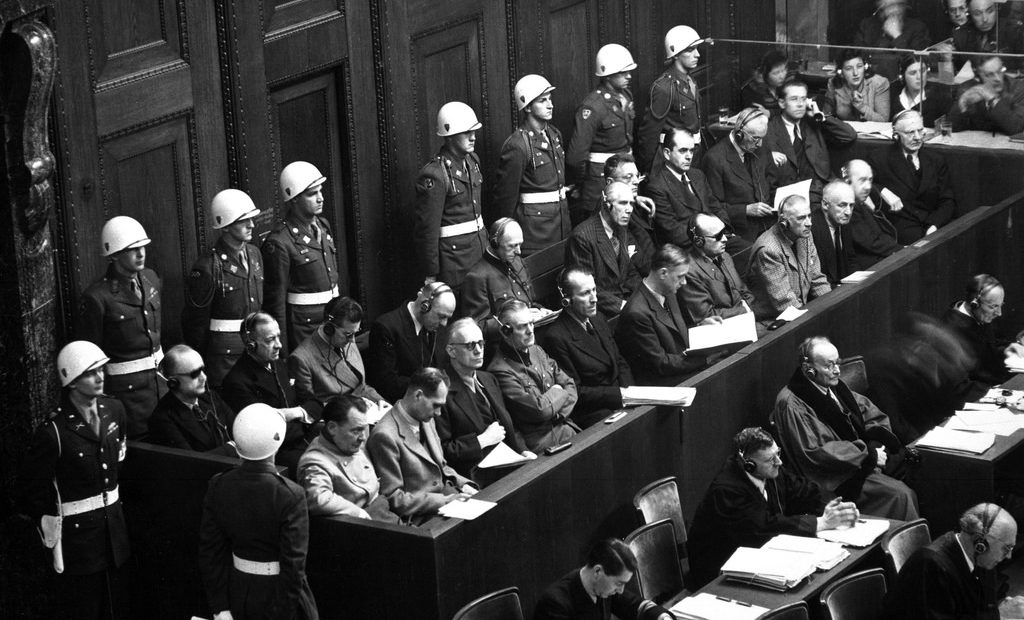
The IMT commenced proceedings in Nuremberg in November 1945, marking the first time in history that an international tribunal heard cases of war crimes, crimes against the peace, and crimes against humanity. War crimeswere defined in the tribunal’s Charter as “violations of the laws or customs of war,” including, “but not . . . limited to”
murder, ill-treatment or deportation to slave labor or for any other purpose of civilian population of or in occupied territory, murder or ill-treatment of prisoners of war or persons on the seas, killing of hostages, plunder of public or private property, wanton destruction of cities, towns or villages, or devastation not justified by military necessity.
*Charter of the International Military Tribunal—Annex to the Agreement for the Prosecution and Punishment of the Major War Criminals of the European Axis art. 6, Aug. 8, 1945, 58 Stat. 1544, 82 U.N.T.S. 280.
In its judgment, the tribunal addressed the question of individual responsibility in conclusory—and, it is widely agreed, unsatisfactory—terms, even though it had carefully crafted arguments available to it. It stated that “crimes against international law are committed by men, not by abstract entities, and only by punishing individuals who commit such crimes can the provisions of international law be enforced.” To ground this finding, the tribunal simply explained: “Enough has been said to show that individuals can be punished for violations of International Law.” In an attempt to justify this approach to what was a skeptical international legal audience, the tribunal pointed to the United States’ prosecution of eight German saboteurs in Ex Parte Quirinfor violating the law ofwar by landing in the United States for purposes of spying and sabotage. But many regarded this justification as insufficient—for U.S. court practice was not international practice.
The cursory treatment of concerns about retroactivity opened the door to accusations that the tribunal had ignored the dictates of justice. While Nuremberg was a signal moment in the evolution of international criminal law, establishing that individuals could be held criminally liable for illegally waged war, the failure of the tribunal to fully and adequately justify that liability had a corrosive effect on the international criminal law that followed. The resultant criticism of the judgment at Nuremberg may have played a role in the decades-long stasis in international criminal law prosecutions that followed the trials. It was not really until the International Criminal Tribunal for the Former Yugoslavia (ICTY) was launched in 1993 that the world again attempted international prosecutions for war crimes. Moreover, the tribunals that addressed war crimes post-Nuremberg took pains to explain that the crimes they prosecuted had been previously criminalized, thus insulating themselves from the chief critique launched at the IMT. But that very same emphasis on criminalization—whichcourts treated as so essential that they attached it to the very definition of a “war crime”—sowed the seeds of confusion about war crimes that continues today.
* Article: What is a War Crime? Oona A. Hathaway, Paul K. Strauch,Beatrice A. Walton, Zoe A. Y. Weinberg
Definition – ART 8 Rome Statute
War crimes are defined in the statute that established the International Criminal Court, which includes:
- Grave breaches of the Geneva Conventions, such as:
- Willful killing, or causing great suffering or serious injury to body or health
- Torture or inhumane treatment
- Unlawful wanton destruction or appropriation of property
- Forcing a prisoner of war to serve in the forces of a hostile power
- Depriving a prisoner of war of a fair trial
- Unlawful deportation, confinement or transfer
- Taking hostages
- Directing attacks against civiliansBodo League massacre during the Korean War in 1950
- Directing attacks against humanitarian workers or UN peacekeepers
- Killing a surrendered combatant
- Misusing a flag of truce
- Settlement of occupied territory
- Deportation of inhabitants of occupied territory
- Using poison weapons
- Using civilians as shields
- Using child soldiers
- Firing upon a Combat Medic with clear insignia.
- The following acts as part of a non-international conflict:
- Murder, cruel or degrading treatment and torture
- Directing attacks against civilians, humanitarian workers or UN peacekeepers
- The following acts as part of an international conflict:Civilians killed in shelling in eastern Ukraine. According to the HRW report, “The use of indiscriminate rockets in populated areas violates international humanitarian law, or the laws of war, and may amount to war crimes.”[9]
- Taking hostages
- Summary execution
- Pillage
- Rape, sexual slavery, forced prostitution or forced pregnancy


However the court only has jurisdiction over these crimes where they are “part of a plan or policy or as part of a large-scale commission of such crimes“.
Full version of Art.8
- The Court shall have jurisdiction in respect of war crimes in particular when committed as part of a plan or policy or as part of a large-scale commission of such crimes.
- For the purpose of this Statute, ‘war crimes’ means:
- Grave breaches of the Geneva Conventions of 12 August 1949, namely, any of the following acts against persons or property protected under the provisions of the relevant Geneva Convention:
- Wilful killing
- Torture or inhuman treatment, including biological experiments;
- Wilfully causing great suffering, or serious injury to body or health;
- Extensive destruction and appropriation of property, not justified by military necessity and carried out unlawfully and wantonly;
- Compelling a prisoner of war or other protected person to serve in the forces of a hostile Power;
- Wilfully depriving a prisoner of war or other protected person of the rights of fair and regular trial;
- Unlawful deportation or transfer or unlawful confinement;
- Taking of hostages.
- Other serious violations of the laws and customs applicable in international armed conflict, within the established framework of international law, namely, any of the following acts:
- Intentionally directing attacks against the civilian population as such or against individual civilians not taking direct part in hostilities;
- Intentionally directing attacks against civilian objects, that is, objects which are not military objectives;
- Intentionally directing attacks against personnel, installations, material, units or vehicles involved in a humanitarian assistance or peacekeeping mission in accordance with the Charter of the United Nations, as long as they are entitled to the protection given to civilians or civilian objects under the international law of armed conflict;
- Intentionally launching an attack in the knowledge that such attack will cause incidental loss of life or injury to civilians or damage to civilian objects or widespread, long-term and severe damage to the natural environment which would be clearly excessive in relation to the concrete and direct overall military advantage anticipated;
- Attacking or bombarding, by whatever means, towns, villages, dwellings or buildings which are undefended and which are not military objectives;
- Killing or wounding a combatant who, having laid down his arms or having no longer means of defence, has surrendered at discretion;
- Making improper use of a flag of truce, of the flag or of the military insignia and uniform of the enemy or of the United Nations, as well as of the distinctive emblems of the Geneva Conventions, resulting in death or serious personal injury;
- The transfer, directly or indirectly, by the Occupying Power of parts of its own civilian population into the territory it occupies, or the deportation or transfer of all or parts of the population of the occupied territory within or outside this territory;
- Intentionally directing attacks against buildings dedicated to religion, education, art, science or charitable purposes, historic monuments, hospitals and places where the sick and wounded are collected, provided they are not military objectives;
- Subjecting persons who are in the power of an adverse party to physical mutilation or to medical or scientific experiments of any kind which are neither justified by the medical, dental or hospital treatment of the person concerned nor carried out in his or her interest, and which cause death to or seriously endanger the health of such person or persons;
- Killing or wounding treacherously individuals belonging to the hostile nation or army;
- Declaring that no quarter will be given;
- Destroying or seizing the enemy’s property unless such destruction or seizure be imperatively demanded by the necessities of war;
- Declaring abolished, suspended or inadmissible in a court of law the rights and actions of the nationals of the hostile party;
- Compelling the nationals of the hostile party to take part in the operations of war directed against their own country, even if they were in the belligerent’s service before the commencement of the war;
- Pillaging a town or place, even when taken by assault;
- Employing poison or poisoned weapons;
- Employing asphyxiating, poisonous or other gases, and all analogous liquids, materials or devices;
- Employing bullets which expand or flatten easily in the human body, such as bullets with a hard envelope which does not entirely cover the core or is pierced with incisions;
- Employing weapons, projectiles and material and methods of warfare which are of a nature to cause superfluous injury or unnecessary suffering or which are inherently indiscriminate in violation of the international law of armed conflict, provided that such weapons, projectiles and material and methods of warfare are the subject of a comprehensive prohibition and are included in an annex to this Statute, by an amendment in accordance with the relevant provisions set forth in articles 121 and 123;
- Committing outrages upon personal dignity, in particular humiliating and degrading treatment;
- Committing rape, sexual slavery, enforced prostitution, forced pregnancy, as defined in article 7, paragraph 2 (f), enforced sterilization, or any other form of sexual violence also constituting a grave breach of the Geneva Conventions;
- Utilizing the presence of a civilian or other protected person to render certain points, areas or military forces immune from military operations;
- Intentionally directing attacks against buildings, material, medical units and transport, and personnel using the distinctive emblems of the Geneva Conventions in conformity with international law;
- Intentionally using starvation of civilians as a method of warfare by depriving them of objects indispensable to their survival, including wilfully impeding relief supplies as provided for under the Geneva Conventions;
- Conscripting or enlisting children under the age of fifteen years into the national armed forces or using them to participate actively in hostilities.
- In the case of an armed conflict not of an international character, serious violations of article 3 common to the four Geneva Conventions of 12 August 1949, namely, any of the following acts committed against persons taking no active part in the hostilities, including members of armed forces who have laid down their arms and those placed hors de combat by sickness, wounds, detention or any other cause:
- Violence to life and person, in particular murder of all kinds, mutilation, cruel treatment and torture;
- Committing outrages upon personal dignity, in particular humiliating and degrading treatment;
- Taking of hostages;
- The passing of sentences and the carrying out of executions without previous judgement pronounced by a regularly constituted court, affording all judicial guarantees which are generally recognized as indispensable.
- Paragraph 2 (c) applies to armed conflicts not of an international character and thus does not apply to situations of internal disturbances and tensions, such as riots, isolated and sporadic acts of violence or other acts of a similar nature.
- Other serious violations of the laws and customs applicable in armed conflicts not of an international character, within the established framework of international law, namely, any of the following acts:
- Intentionally directing attacks against the civilian population as such or against individual civilians not taking direct part in hostilities;
- Intentionally directing attacks against buildings, material, medical units and transport, and personnel using the distinctive emblems of the Geneva Conventions in conformity with international law;
- Intentionally directing attacks against personnel, installations, material, units or vehicles involved in a humanitarian assistance or peacekeeping mission in accordance with the Charter of the United Nations, as long as they are entitled to the protection given to civilians or civilian objects under the international law of armed conflict;
- Intentionally directing attacks against buildings dedicated to religion, education, art, science or charitable purposes, historic monuments, hospitals and places where the sick and wounded are collected, provided they are not military objectives;
- Pillaging a town or place, even when taken by assault;
- Committing rape, sexual slavery, enforced prostitution, forced pregnancy, as defined in article 7, paragraph 2 (f), enforced sterilization, and any other form of sexual violence also constituting a serious violation of article 3 common to the four Geneva Conventions;
- Conscripting or enlisting children under the age of fifteen years into armed forces or groups or using them to participate actively in hostilities;
- Ordering the displacement of the civilian population for reasons related to the conflict, unless the security of the civilians involved or imperative military reasons so demand;
- Killing or wounding treacherously a combatant adversary;
- Declaring that no quarter will be given;
- Subjecting persons who are in the power of another party to the conflict to physical mutilation or to medical or scientific experiments of any kind which are neither justified by the medical, dental or hospital treatment of the person concerned nor carried out in his or her interest, and which cause death to or seriously endanger the health of such person or persons;
- Destroying or seizing the property of an adversary unless such destruction or seizure be imperatively demanded by the necessities of the conflict;
- Paragraph 2 (e) applies to armed conflicts not of an international character and thus does not apply to situations of internal disturbances and tensions, such as riots, isolated and sporadic acts of violence or other acts of a similar nature. It applies to armed conflicts that take place in the territory of a State when there is protracted armed conflict between governmental authorities and organized armed groups or between such groups.
- Grave breaches of the Geneva Conventions of 12 August 1949, namely, any of the following acts against persons or property protected under the provisions of the relevant Geneva Convention:
- Nothing in paragraph 2 (c) and (e) shall affect the responsibility of a Government to maintain or re-establish law and order in the State or to defend the unity and territorial integrity of the State, by all legitimate means.
Elements of the Crime
War crimes are those violations of international humanitarian law (treaty or customary law) that incur individual criminal responsibility under international law. As a result, and in contrast to the crimes of genocide and crimes against humanity, war crimes must always take place in the context of an armed conflict, either international or non-international.
What constitutes a war crime may differ, depending on whether an armed conflict is international or non-international. For example, Article 8 of the Rome Statute categorises war crimes as follows:
- Grave breaches of the 1949 Geneva Conventions, related to international armed conflict;
- Other serious violations of the laws and customs applicable in international armed conflict;
- Serious violations of Article 3 common to the four 1949 Geneva Conventions, related to armed conflict not of an international character;
- Other serious violations of the laws and customs applicable in armed conflict not of an international character.
From a more substantive perspective, war crimes could be divided into:
a) war crimes against persons requiring particular protection;
b) war crimes against those providing humanitarian assistance and peacekeeping operations;
c) war crimes against property and other rights;
d) prohibited methods of warfare; and
e) prohibited means of warfare.
Some examples of prohibited acts include: murder; mutilation, cruel treatment and torture; taking of hostages; intentionally directing attacks against the civilian population; intentionally directing attacks against buildings dedicated to religion, education, art, science or charitable purposes, historical monuments or hospitals; pillaging; rape, sexual slavery, forced pregnancy or any other form of sexual violence; conscripting or enlisting children under the age of 15 years into armed forces or groups or using them to participate actively in hostilities.
War crimes contain two main elements:
- A contextual element: “the conduct took place in the context of and was associated with an international/non-international armed conflict”;
- A mental element: intent and knowledge both with regards to the individual act and the contextual element.
In contrast to genocide and crimes against humanity, war crimes can be committed against a diversity of victims, either combatants or non-combatants, depending on the type of crime. In international armed conflicts, victims include wounded and sick members of armed forces in the field and at sea, prisoners of war and civilian persons. In the case of non-international armed conflicts, protection is afforded to persons taking no active part in the hostilities, including members of armed forces who have laid down their arms and those placed ‘hors de combat’ by sickness, wounds, detention, or any other cause. In both types of conflicts protection is also afforded to medical and religious personnel, humanitarian workers and civil defence staff.
International treaties on the laws of war
List of declarations, conventions, treaties, and judgments on the laws of war:
- 1856 Paris Declaration Respecting Maritime Law abolished privateering.
- 1864 Geneva Convention for the Amelioration of the Condition of the Wounded and Sick in Armed Forces in the Field.[29]
- 1868 St. Petersburg Declaration Renouncing the Use of Explosive projectiles Under 400 grams Weight.
- 1874 Project of an International Declaration concerning the Laws and Customs of War (Brussels Declaration).[30] Signed in Brussels 27 August. This agreement never entered into force, but formed part of the basis for the codification of the laws of war at the 1899 Hague Peace Conference.[31][32]
- 1880 Manual of the Laws and Customs of War at Oxford. At its session in Geneva in 1874 the Institute of International Law appointed a committee to study the Brussels Declaration of the same year and to submit to the Institute its opinion and supplementary proposals on the subject. The work of the Institute led to the adoption of the Manual in 1880 and it went on to form part of the basis for the codification of the laws of war at the 1899 Hague Peace Conference.[32]
- 1899 Hague Conventions consisted of three main sections and three additional declarations:
- I – Pacific Settlement of International Disputes
- II – Laws and Customs of War on Land
- III – Adaptation to Maritime Warfare of Principles of Geneva Convention of 1864
- Declaration I – On the Launching of Projectiles and Explosives from Balloons
- Declaration II – On the Use of Projectiles the Object of Which is the Diffusion of Asphyxiating or Deleterious Gases
- Declaration III – On the Use of Bullets Which Expand or Flatten Easily in the Human Body
- 1907 Hague Conventions had thirteen sections, of which twelve were ratified and entered into force, and two declarations:
- I – The Pacific Settlement of International Disputes
- II – The Limitation of Employment of Force for Recovery of Contract Debts
- III – The Opening of Hostilities
- IV – The Laws and Customs of War on Land
- V – The Rights and Duties of Neutral Powers and Persons in Case of War on Land
- VI – The Status of Enemy Merchant Ships at the Outbreak of Hostilities
- VII – The Conversion of Merchant Ships into War-ships
- VIII – The Laying of Automatic Submarine Contact Mines
- IX – Bombardment by Naval Forces in Time of War
- X – Adaptation to Maritime War of the Principles of the Geneva Convention
- XI – Certain Restrictions with Regard to the Exercise of the Right of Capture in Naval War
- XII – The Creation of an International Prize Court [Not Ratified]*
- XIII – The Rights and Duties of Neutral Powers in Naval War
- Declaration I – extending Declaration II from the 1899 Conference to other types of aircraft
- Declaration II – on the obligatory arbitration
- 1909 London Declaration concerning the Laws of Naval War largely reiterated existing law, although it showed greater regard to the rights of neutral entities. Never went into effect.
- 1922 The Washington Naval Treaty, also known as the Five-Power Treaty (6 February)
- 1923 Hague Draft Rules of Aerial Warfare. Never adopted in a legally binding form.[33]
- 1925 Geneva protocol for the Prohibition of the Use in War of Asphyxiating, Poisonous or Other Gases, and of Bacteriological Methods of Warfare.[34]
- 1927–1930 Greco-German arbitration tribunal
- 1928 Kellogg-Briand Pact (also known as the Pact of Paris)
- 1929 Geneva Convention, Relative to the treatment of prisoners of war.
- 1929 Geneva Convention on the amelioration of the condition of the wounded and sick
- 1930 Treaty for the Limitation and Reduction of Naval Armament (22 April)
- 1935 Roerich Pact
- 1936 Second London Naval Treaty (25 March)
- 1938 Amsterdam Draft Convention for the Protection of Civilian Populations Against New Engines of War. This convention was never ratified.[35]
- 1938 League of Nations declaration for the “Protection of Civilian Populations Against Bombing From the Air in Case of War”[36]
- 1945 United Nations Charter (entered into force on October 24, 1945)
- 1946 Judgment of the International Military Tribunal at Nuremberg
- 1947 Nuremberg Principles formulated under UN General Assembly Resolution 177, 21 November 1947
- 1948 United Nations Convention on the Prevention and Punishment of the Crime of Genocide
- 1949 Geneva Convention I for the Amelioration of the Condition of the Wounded and Sick in Armed Forces in the Field
- 1949 Geneva Convention II for the Amelioration of the Condition of Wounded, Sick and Shipwrecked Members of Armed Forces at Sea
- 1949 Geneva Convention III Relative to the Treatment of Prisoners of War
- 1949 Geneva Convention IV Relative to the Protection of Civilian Persons in Time of War
- 1954 Hague Convention for the Protection of Cultural Property in the Event of Armed Conflict
- 1971 Zagreb Resolution of the Institute of International Law on Conditions of Application of Humanitarian Rules of Armed Conflict to Hostilities in which the United Nations Forces May be Engaged
- 1974 United Nations Declaration on the Protection of Women and Children in Emergency and Armed Conflict
- 1977 United Nations Convention on the Prohibition of Military or Any Other Hostile Use of Environmental Modification Techniques
- 1977 Geneva Protocol I Additional to the Geneva Conventions of 12 August 1949, and Relating to the Protection of Victims of International Armed Conflicts
- 1977 Geneva Protocol II Additional to the Geneva Conventions of 12 August 1949, and Relating to the Protection of Victims of Non-International Armed Conflicts
- 1978 Red Cross Fundamental Rules of International Humanitarian Law Applicable in Armed Conflicts
- 1980 United Nations Convention on Prohibitions or Restrictions on the Use of Certain Conventional Weapons Which May be Deemed to be Excessively Injurious or to Have Indiscriminate Effects (CCW)
- 1980 Protocol I on Non-Detectable Fragments
- 1980 Protocol II on Prohibitions or Restrictions on the Use of Mines, Booby-Traps and Other Devices
- 1980 Protocol III on Prohibitions or Restrictions on the Use of Incendiary Weapons
- 1995 Protocol IV on Blinding Laser Weapons
- 1996 Amended Protocol II on Prohibitions or Restrictions on the Use of Mines, Booby-Traps and Other Devices
- Protocol on Explosive Remnants of War (Protocol V to the 1980 Convention), 28 November 2003 (entered into force 12 November 2006)[37]
- 1994 San Remo Manual on International Law Applicable to Armed Conflicts at Sea[38]
- 1994 ICRC/UNGA Guidelines for Military Manuals and Instructions on the Protection of the Environment in Time of Armed Conflict[39]
- 1994 UN Convention on the Safety of United Nations and Associated Personnel.[40]
- 1996 The International Court of Justice advisory opinion on the Legality of the Threat or Use of Nuclear Weapons
- 1997 Ottawa Treaty – Convention on the Prohibition of the Use, Stockpiling, Production and Transfer of Anti-Personnel Mines and on their Destruction
- 1998 Rome Statute of the International Criminal Court (entered into force 1 July 2002)
- 2000 Optional Protocol on the Involvement of Children in Armed Conflict (entered into force 12 February 2002)
- 2005 Geneva Protocol III Additional to the Geneva Conventions of 12 August 1949, and Relating to the Adoption of an Additional Distinctive Emblem
- 2008 Convention on Cluster Munitions (entered into force 1 August 2010)
List of War Crimes commited since Second Boer War
1899–1902 Second Boer War
See also: British concentration camps

Lizzie van Zyl, a Boer child in a British concentration camp
The term “concentration camp” was used to describe camps operated by the British Empire in South Africa during the Second Boer War in the years 1900–1902. As Boer farms were destroyed by the British under their “Scorched Earth” policy, many tens of thousands of women and children were forcibly moved into the concentration camps. Over 26,000 Boer women and children were to perish in these concentration camps.[2]
1899–1902 Philippine–American War
See also: United States Senate Committee on the Philippines § Investigation, and American war crimes
In November 1901, the Manila correspondent of the Philadelphia Ledger wrote: “The present war is no bloodless, opera bouffe engagement; our men have been relentless, have killed to exterminate men, women, children, prisoners and captives, active insurgents and suspected people from lads of ten up, the idea prevailing that the Filipino as such was little better than a dog…”[3]
In response to the Balangiga massacre, which wiped out a U.S. company garrisoning Samar town, U.S. Brigadier General Jacob H. Smith launched a retaliatory march across Samar with the instructions: “I want no prisoners. I wish you to kill and burn, the more you kill and burn the better it will please me. I want all persons killed who are capable of bearing arms in actual hostilities against the United States, …”[4][5]
The war resulted in the deaths of at least 200,000 Filipino civilians.[6] Some estimates for total civilian dead reach up to 1,000,000.[7][8]
1914–1918: World War I

Austro-Hungarian troops executing captured Serbians, 1917. Serbia lost about 850,000 people during the war, a quarter of its pre-war population.[9]
World War I was the first major international conflict to take place following the codification of war crimes at the Hague Convention of 1907, including derived war crimes, such as the use of poisons as weapons, as well as crimes against humanity, and derivative crimes against humanity, such as torture, and genocide. Before, the Second Boer War took place after the Hague Convention of 1899. The Second Boer War (1899 until 1902) is known for the first concentration camps (1900 until 1902) for civilians in the 20th century.
| Armed conflict | Perpetrator | ||
|---|---|---|---|
| Incident | Type of crime | Persons responsible | Notes |
| World War I | German Empire (Imperial Germany) | ||
| Rape of Belgium | War crimes | No prosecutions | In defiance of the 1907 Hague Convention on Land Warfare, the German occupiers engaged in mass atrocities against the civilian population of Belgium and looting and destruction of civilian property, in order to flush out the Belgian guerrilla fighters, or francs-tireurs, in the first two months of the war, after the German invasion of Belgium in August 1914.[10] As Belgium was officially neutral after hostilities in Europe broke out and Germany invaded the country without explicit warning, this act was also in breach of the treaty of 1839 and the 1907 Hague Convention on Opening of Hostilities.[11] |
| World War I | All major belligerents | ||
| Employment of poison gas | Use of poisons as weapons | No prosecutions | Poison gas was introduced by Imperial Germany, and was subsequently used by all major belligerents in the war, in violation of the 1899 Hague Declaration Concerning Asphyxiating Gases and the 1907 Hague Convention on Land Warfare[12][13] |
| World War I | Ottoman Empire | ||
| Armenian Genocide[14][15][16][17][18][19] | War crimes, crimes against humanity, crime of genocide (Extermination of Armenians in Western Armenia) | The Turkish Courts-Martial of 1919–20 as well as the incomplete Malta Tribunals were trials of certain of the alleged perpetrators. | The Young Turk regime ordered the wholesale extermination of Armenians living within Western Armenia. This was carried out by certain elements of their military forces, who either massacred Armenians outright, or deported them to Syria and then massacred them. Over 1.5 million Armenians perished.[citation needed] The Republic of Turkey, the successor state of the Ottoman Empire, does not accept the word genocide as an accurate description of the events surrounding this matter.[20] |
| Assyrian Genocide | War Crimes, Crimes against humanity, genocide, ethnic cleansing | Turkish Courts-Martial of 1919-20 | Mass killing of Assyrian civilians by the Ottoman Empire’s forces resulting in the deaths of hundreds of thousands. Turkey does not call the event genocide. |
| Greek genocide | War Crimes, Crimes against humanity, genocide, ethnic cleansing | Turkish Courts-Martial of 1919-20 | Violent Ethnic Cleansing campaign against Greeks in Anatolia resulting in the deaths of hundreds of thousands. Turkey does not call the event genocide. |
| World War I | United Kingdom | ||
| Baralong Incidents | War crimes (murder of shipwreck survivors) | No prosecutions | On 19 August 1915, a German submarine, U-27, while preparing to sink the British freighter Nicosian, which was loaded with war supplies, after the crew had boarded the lifeboats, was sunk by the British Q-ship HMS Baralong. Afterwards, Lieutenant Godfrey Herbert ordered his Baralong crew to kill the survivors of the German submarine while still at sea, including those who were summarily executed after boarding the Nicosian. The massacre was reported to a newspaper by American citizens who were also on board the Nicosian.[21] Another attack occurred on 24 September a month later when Baralong destroyed U-41, which was in the process of sinking the cargo ship Urbino. According to U41’s commander Karl Goetz, the British vessel was flying the American flag even after opening fire on the submarine, and the lifeboat carrying the German survivors was rammed and sunk by the British Q-ship.[22] |
| World War I | Russian Empire | ||
| Urkun | War Crimes, Crimes against humanity, Genocide | No prosecutions | Urkun was not covered by Soviet textbooks, and monographs on the subject were removed from Soviet printing houses. As the Soviet Union was disintegrating in 1991, interest in Urkun grew. Some survivors have begun to label the events a “massacre” or “genocide.”[23] In August 2016, a public commission in Kyrgyzstan concluded that the 1916 mass crackdown was labelled as “genocide.”[24] Arnold Toynbee alleges 500,000 Central Asian Turks perished under the Russian Empire though he admits this is speculative.[25] Rudolph Rummel citing Toynbee states 500,000 perished within the revolt.[26][unreliable source?] Kyrgyz sources put the death toll between 100,000 and 270,000. Russian sources put the figure at 3,000.[27] Kyrgyz historian Shayyrkul Batyrbaeva puts the death toll at 40,000, based on population tallies.[citation needed] |
| Turkish massacre of the Kurds | War crimes, discrimination, massacres, Genocide | No prosecutions | Kurds raped, massacred and slaughtered by the Ottoman Empire during the same period of time as Ottaman perpetrated the Armenian Genocide (1,6 million deaths, 24 april 1915-16) as well as Assyrians. |
| Deportation of Volhynia Germans | War Crimes, Crimes against humanity | Although Germans were permitted to return and attempt to reclaim their land, it is estimated that only one-half of their number did so. Many found their houses destroyed and their farms occupied by strangers.[28] | Grand Duke Nicolas (who was still commander-in-chief of the Western forces), after suffering serious defeats at the hands of the German army, decided to implement the decrees for the German Russians living under his army’s control, principally in the Volhynia province. The lands were to be expropriated, and the owners deported to Siberia. The land was to be given to Russian war veterans once the war was over. In July 1915, without prior warning, 150,000 German settlers from Volhynia were arrested and shipped to internal exile in Siberia and Central Asia. (Some sources indicate that the number of deportees reached 200,000). Ukrainian peasants took over their lands. The mortality rate from these deportations is estimated to have been 63,000 to 100,000, that is from 30% to 50%, but exact figures are impossible to determine.[citation needed] |
1923–1932: Pacification of Libya
- The Pacification of Libya resulted in mass deaths of the indigenous people in Cyrenaica by Italy. 80,000 or over a quarter[29][30] of the indigenous people in Cyrenaica perished during the pacification.
- 100,000 Bedouin citizens were ethnically cleansed by expulsion from their land.[31]
- Specific war crimes alleged to have been committed by the Italian armed forces against civilians include deliberate bombing of civilians, killing unarmed children, women, and the elderly, rape and disembowelment of women, throwing prisoners out of aircraft to their death and running over others with tanks, regular daily executions of civilians in some areas, and bombing tribal villages with mustard gas bombs beginning in 1930.[32]
1935–1941: Second Italo-Abyssinian War
- Italian use of mustard gas against Ethiopian soldiers in 1936 violated the 1925 Geneva Protocol, which bans the use of chemical weapons in warfare.
- Yekatit 12—In response to the unsuccessful assassination of Rodolfo Graziani on 19 February 1937, thousands of Ethiopians were killed, including all of the monks residing at Debre Libanos, and over a thousand more detained at Danan who were then exiled either to the Dahlak Islands or Italy.[33]
- The Ethiopians recorded 275,000 combatants killed in action, 78,500 patriots (guerrilla fighters) killed during the occupation, 17,800 civilians killed by aerial bombardment and 30,000 in the February 1937 massacre, 35,000 people died in concentration camps, 24,000 patriots executed by Summary Courts, 300,000 persons died of privation due to the destruction of their villages, amounting to 760,300 deaths.[34]
1936–1939: Spanish Civil War

Republicans executed by Francoists at the beginning of the Spanish Civil War
At least 50,000 people were executed during the Spanish Civil War.[35][36] In his updated history of the Spanish Civil War, Antony Beevor writes, “Franco’s ensuing ‘white terror‘ claimed 200,000 lives. The ‘red terror‘ had already killed 38,000.”[37] Julius Ruiz[who?]concludes that “although the figures remain disputed, a minimum of 37,843 executions were carried out in the Republican zone with a maximum of 150,000 executions (including 50,000 after the war) in Nationalist Spain.”[38]
César Vidal puts the number of Republican victims at 110,965.[39] In 2008 a Spanish judge, Socialist Baltasar Garzón, opened an investigation into the executions and disappearances of 114,266 people between 17 July 1936 and December 1951. Among the murders and executions investigated was that of poet and dramatist Federico García Lorca.[40][41]
1939–1945: World War II
Axis powers
The Axis Powers (Germany, Italy, and Japan) were some of the most systematic perpetrators of war crimes in modern history. Contributing factors included Nazi race theory, a desire for “living space” that justified the eradication of native populations, and militaristic indoctrination that encouraged the terrorization of conquered peoples and prisoners of war. The Holocaust, the German attack on the Soviet Union and occupation of much of Europe, the Japanese occupation of Manchuria and the Philippines and attack on China all contributed to well over half of the civilian deaths in World War II and the conflicts that led up to the war. Even before post-war revelations of atrocities, Axis militaries were notorious for their brutal treatment of captured combatants.
Crimes perpetrated by Germany
Further information: Nazi Germany, German war crimes § World War II, and Consequences of Nazism
According to the Nuremberg Trials, there were four major war crimes that were alleged against German military (and Waffen-SS and NSDAP) men and officers, each with individual events that made up the major charges.
1. Participation in a common plan of conspiracy for the accomplishment of crimes against peace
2. Planning, initiating and waging wars of aggression and other crimes against peace
- Planning and executing a campaign of invasion of its European neighbors, as well as the conspiracy to violate the Treaty of Versailles and the Treaty of Saint-Germain through the remilitarization of the Rhineland, and the annexations of Austria and Czechoslovakia.
3. War Crimes Atrocities against enemy combatants or conventional crimes committed by military units (see War crimes of the Wehrmacht), and include:
- Invasion of Poland: During the period of 1 September – 25 October 1939 German forces in their military actions engaged in executions of Polish POWs, bombing hospitals, murdering civilians, shooting refugees, and executing wounded soldiers. The cautious estimates give a number of at least 16,000 murdered victims.[42]
- Pacification Operations in German occupied Poland: During the occupation of Poland by German Reich, Wehrmacht forces took part in several pacification actions in rural areas, that resulted in murder of at least 20,000 Polish villagers.
- Le Paradis massacre: In May 1940, British soldiers of the Royal Norfolk Regiment were captured by the SS and subsequently murdered. Fritz Knoechlein was tried found guilty and hanged.
- Wormhoudt massacre: In May 1940, British and French soldiers were captured by the SS and subsequently murdered. No one found guilty of the crime.
- d’Ardenne Massacres: In June 1944 Canadian soldiers were captured by the SS and murdered by the 12th SS Panzer Division Hitlerjugend. SS General Kurt Meyer (Panzermeyer) was sentenced to be shot 1946. His sentence was commuted and he was released in 1954.
- Malmedy massacre: In December 1944, United States POWs captured by Kampfgruppe Peiper were murdered outside Malmedy, Belgium.
.jpg)
Announcement of execution of 150 Polish hostages as revenge for assassination of 6 Germans, Warsaw, Nazi-occupied Poland, May 1944 Gardelegen (war crime): The German SS forced 1,016 slave laborers who were part of transports evacuated from several sub-camps of Mittelbau-Dora Concentration Camp and from the sub-camp Hannover-Stöcken of Neuengamme Concentration Camp into a large barn which was then lit on fire. Most of the prisoners were burned alive; some were shot trying to escape. Marzabotto massacre: The German SS killing of at least 770 civilians of Marzabotto as a collective punishment for their support of Italian partisans and the Italian resistance movementSant’Anna di Stazzema massacre: A massacre was committed in the hill village of Sant’Anna di Stazzema in Tuscany, Italy, in the course of an operation against the Italian resistance movement during the Italian Campaign of World War II. 560 local villagers and refugees were murdered and their bodies burnt in a scorched earth policy action by the Nazis. Cefalonia Massacre: The mass execution of the men of the Italian 33rd Acqui Infantry Division by the Germans on the island of Cephalonia, Greece was committed after the Italian armistice. Oradour-sur-Glane massacre: On 10 June 1944, the village of Oradour-sur-Glane in Haute-Vienne in then Nazi occupied France was destroyed. 642 of its inhabitants, including women and children, were massacred by a Waffen-SS company. The annihilation of the Czech city of Lidice was committed as an act of vengeance for the assassination of Reinhard Heydrich. Massacre of Kalavryta: The extermination of the male population and the total destruction of the town of Kalavryta, in Greece, by German occupying forces during World War II, was committed on 13 December 1943. Distomo massacre: This attack was perpetrated by members of the Waffen-SS in the village of Distomo, Greece, during the Axis occupation of Greece during World War II. Kragujevac massacre: This was a nazi war crime in which Serbs, Jews and Roma men and boys in Kragujevac, Serbia, were murdered by GermanWehrmacht soldiers on 20 and 21 October 1941. The suppression of the 1944 Warsaw Uprising and subsequent leveling of the whole city was a war crime.

- Naked Soviet prisoners of war in Mauthausen concentration camp. Unknown date
- The treatment of Soviet POWs throughout the war, who were not given the protections and guarantees of the Geneva Convention unlike other Allied prisoners was a war crime. Nazi crimes against Soviet POWs, resulted in some 3.3 million to 3.5 million deaths. This accounts for about 60% of all Soviet POWs.[43]
- Unrestricted submarine warfare against merchant shipping was another war crime.
- Commando Order which stated that Allied combatants encountered during commando operations were to be executed immediately upon capture and without trial, even if they were properly uniformed, unarmed, or intending to surrender was a war crime.
- Commissar Order: An order stating that Soviet political commissars found among captured troops were to be executed immediately was a war crime.
- Vinkt Massacre: In May 1940 at least 86 civilians in Vinkt were killed by the German Wehrmacht.
- Heusden: A town hall was massacred in November 1944.
- German war crimes during the Battle of Moscow are another example.
4. Crimes against Humanity Crimes committed well away from the lines of battle and unconnected in any way to military activity, distinct from war crimes
- The major crime was the Holocaust, including:
- The construction and use of Vernichtungslagern (extermination camps) to commit genocide, most prominently at Auschwitz, Treblinka, Majdanek, Bełżec, Sobibór, and Chełmno
- The employment of other concentration camps across Europe, including Dachau, Sachsenhausen, Mauthausen and Bergen-Belsen, which held Soviet POWs and political prisoners in inhuman conditions, and transported Jews and Roma to extermination camps
- Death marches of prisoners, particularly in the last months of the war when the aforementioned camps were being overrun by the Allies
- The widespread use of slave labor and forced/unfree labor by the Nazi regime, including the use of concentration camp and extermination camp prisoners as slaves, often with the intent of extermination through labor
- The construction and use of Vernichtungslagern (extermination camps) to commit genocide, most prominently at Auschwitz, Treblinka, Majdanek, Bełżec, Sobibór, and Chełmno

German police shooting women and children from the Mizocz Ghetto, 14 October 1942 The establishment of Jewish Ghettos in Eastern Europe intended to isolate Jewish communities for deportation and subsequent extermination The use of SSEinsatzgruppen, mobile extermination squads, to exterminate Jews and anti-nazi “partisans”
- Babi Yar a series of massacres in Kiev, the most notorious and the best documented of these massacres took place on 29–30 September 1941, wherein 33,771 Jews were killed in a single operation. The decision to kill all the Jews in Kiev was made by the military governor, Major-General Kurt Eberhard, the Police Commander for Army Group South, SS-Obergruppenführer Friedrich Jeckeln, and the Einsatzgruppe C Commander Otto Rasch. It was carried out by Sonderkommando 4a soldiers, along with the aid of the SD and SS Police Battalions backed by the local police.
- Rumbula a collective term for incidents on two non-consecutive days (November 30 and December 8, 1941) in which about 25,000 Jews were killed in or on the way to Rumbula forest near Riga, Latvia, during the Holocaust
- Ninth Fort By the order of SS-Standartenführer Karl Jäger and SS-Rottenführer Helmut Rauca, the Sonderkommando under the leadership of SS-Obersturmführer Joachim Hamann, and 8 to 10 men from Einsatzkommando 3, in collaboration with Lithuanian partisans, murdered 2,007 Jewish men, 2,920 women, and 4,273 children in a single day at the Ninth Fort, Kaunas, Lithuania.
- Simferopol Germans perpetrated one of the largest war-time massacres in Simferopol, killing in total over 22,000 locals—mostly Jews, Russians, Krymchaks, and Gypsies.[44] On one occasion, starting December 9, 1941, the Einsatzgruppen D under Otto Ohlendorf‘s command killed an estimated 14,300 Simferopol residents, most of them being Jews.[45]
- The massacre of 100,000 Jews and Poles at Paneriai
The suppression of the 1943 Warsaw Ghetto Uprising which erupted when the SS came to clear the Jewish ghetto and send all of the occupants to extermination camps

- Aleksandras Lileikis, a Nazi Saugumas unit commander who oversaw the murder of 60,000 Jews in Lithuania. He later worked for the CIA.[46]
- Izieu Massacre Izieu was the site of a Jewish orphanage during the Second World War. On 6 April 1944, three vehicles pulled up in front of the orphanage. The Gestapo, under the direction of the ‘Butcher of Lyon’ Klaus Barbie, entered the orphanage and forcibly removed the forty-four children and their seven supervisors, throwing the crying and terrified children on to the trucks. Following the raid on their home in Izieu, the children were shipped directly to the “collection center” in Drancy, then put on the first available train towards the concentration camps in the East.
Other crimes against humanity included:
- The Porajmos, the mass killings of the Romany peoples of Europe by the Nazis
- The Łapanka or “Catching Game”, – Nazi roundups of Poles in the major cities for slave labor
- Nikolaev Massacre, which resulted in the deaths of 35,782 Soviet citizens, most of whom were Jews.
- Operation Tannenberg, the AB Action and the Massacre of Lwów professors, all Nazi actions in Poland meant to mass murder the Polish intelligentsia and other potential leaders of resistance.[47][48]
- The Nazi T-4 Euthanasia Program, an aborted eugenics program meant to kill German children who were mentally or physically handicapped. 200,000 people were murdered due to this program.
At least 10 million, and perhaps over 20 million perished directly and indirectly due to the commission of crimes against humanity and war crimes by the Nazi regime, of which the Holocaust lives on in particular infamy, for its particularly cruel nature and scope, and the industrialised nature of the genocide of Jewish citizens of states invaded or controlled by the Nazi regime. At least 5.9 million Jews were murdered by the Nazis, or 66 to 78% of Europe’s Jewish population, although a complete count may never be known. Though much of Continental Europe suffered under the Nazi occupation, Poland, in particular, was the state most devastated by these crimes, with 90% of its Jews as well as many ethnic Poles slaughtered by the Nazis and their affiliates. After the war, from 1945–49, the Nazi regime was put on trial in two tribunals in Nuremberg, Germany by the victorious Allied powers.
The first tribunal indicted 24 major Nazi war criminals, and resulted in 19 convictions (of which 12 led to death sentences) and 3 acquittals, 2 of the accused died before a verdict was rendered, at least one of which by killing himself with cyanide.[49] The second tribunal indicted 185 members of the military, economic, and political leadership of Nazi Germany, of which 142 were convicted and 35 were acquitted. In subsequent decades, approximately 20 additional war criminals who escaped capture in the immediate aftermath of World War II were tried in West Germany and Israel. In Germany and many other European nations, the Nazi Party and denial of the Holocaust is outlawed.[citation needed]
Crimes perpetrated by Hungary
| Incident | Type of crime | Persons responsible | Notes |
|---|---|---|---|
| Novi Sad massacre[50][51] | Crimes against humanity | After the war, most of the perpetrators were convicted by the People’s Tribunal. The leaders of the massacre, Ferenc Feketehalmy-Czeydner, József Grassy and Márton Zöldy were sentenced to death and later extradited to Yugoslavia, together with Ferenc Szombathelyi, Lajos Gaál, Miklós Nagy, Ferenc Bajor, Ernő Bajsay-Bauer and Pál Perepatics. After a trial at Novi Sad, all sentenced to death and executed. | 4,211 civilians (2,842 Serbs, 1,250 Jews, 64 Roma, 31 Rusyns, 13 Russians and 11 ethnic Hungarians) rounded up and killed by Hungarian troops in reprisal for resistance activities. |
| Kamianets-Podilskyi massacre[52][53] | Crimes against humanity; Crime of Genocide | After the war, the perpetrator of the massacre, Friedrich Jeckeln was sentenced to death and executed in the Soviet Union. | 14000-16000 Jews were deported by Hungarian troops to Kamianets-Podilskyi to be executed by SS troops. Part of the first large-scale mass murder in pursuit of the “Final Solution”. |
| Sarmasu massacre[54][55] | Crimes against humanity | The People’s Tribunal at Cluj sentenced to death 7 Hungarian officer in absentia, two local Hungarian were sentenced to imprisonment. | Torture and killing of 126 Jews by Hungarian troops in the village of Sarmasu. |
| Treznea massacre[56] | Crimes against humanity | The People’s Tribunal at Cluj sentenced to death Ferenc Bay in absentia, 3 local Hungarian were sentenced to imprisonment, 2 person were acquitted. | 93 to 236 Romanian and Jewish civilians (depending on sources) executed as reprisal for alleged attacks from locals on the Hungarian troops. |
| Ip massacre[56] | Crimes against humanity | A Hungarian officer was sentenced to death by the People’s Tribunal at Cluj in absentia, 13 local Hungarians were sentenced to imprisonment, 2 person were acquitted. | 150 Romanian civilians executed by Hungarian rogue troops and paramilitary formations as reprisal for the death of two Hungarian soldiers in an explosion. |
| Hegyeshalom death march[57][58] | Crimes against humanity; Crime of genocide | After the war most of the responsibles were sentenced by the Hungarian people’s tribunals, including the whole Szálasi-government | About 10,000 Budapest Jews died as a result of exhaustion and executions while marching toward Hegyeshalom at the Austrian border. |
Crimes perpetrated by Italy
Main article: Italian war crimes
- Invasion of Abyssinia: Waging a war of aggression for territorial aggrandisement, war crimes, use of poisons as weapons, crimes against humanity; in violation of the Kellogg-Briand Pact, and the customary law of nations, Italy invaded the Kingdom of Abyssinia in 1936 without cause cognizable by the law of nations, and waged a war of annihilation against Ethiopian resistance, using poisons against military forces and civilian persons alike, not giving quarter to POWs who had surrendered, and massacring civilians.
- Invasion of Albania: Waging a war of aggression for territorial aggrandisement; Italy invaded the Kingdom of Albania in 1939 without cause cognizable by the law of nations in a brief but bloody affair that saw King Zog deposed and an Italian proconsul installed in his place. Italy subsequently acted as the suzerain of Albania until its ultimate liberation later in World War II.
- Invasion of Yugoslavia: Aerial bombardment of civilian population; concentration camps (Rab, Gonars)
- No one has been brought to trial for war crimes, although in 1950 the former Italian defense minister was convicted for collaboration with Nazi Germany.
Crimes perpetrated by the (first) Slovak Republic (1939–1945)
- deportation of around 70 000 Slovak Jews into German Nazi concentration camps
- annihilation of 60 villages and their inhabitants[59]
- deportation of Slovak Jews, Roma and political opponents into Slovak forced labour camps in Sereď, and Nováky
- brought to trial and sentenced to death: Jozef Tiso, Ferdinand Ďurčanský (he fled), Vojtech Tuka and 14 others[60]
Crimes perpetrated by Japan
Main article: Japanese war crimes
This section includes war crimes from 7 December 1941 when the United States was attacked by Japan and entered World War II. For war crimes before this date which took place during the Second Sino-Japanese War, please see the section above which is titled 1937–1945: Second Sino-Japanese War.
| Incident | Type of crime | Persons responsible | Notes |
|---|---|---|---|
| World War II[citation needed] | Crimes against peace (Overall waging and/or conspiracy to wage a war of aggression for territorial aggrandisement, as established by the Tokyo Trials) | General Doihara Kenji, Baron Hirota Koki, General Seishirō Itagaki, General Kimura Heitaro, General Matsui Iwane, General Muto Akira, General Hideki Tōjō, General Araki Sadao, Colonel Hashimoto Kingoro, Field Marshal Hata Shunroku, Baron Hiranuma Kiichiro, Hoshino Naoki, Kaya Okinori, Marquis Kido Kōichi, General Koiso Kuniaki, General Minami Jiro, Admiral Takasumi Oka, General Oshima Hiroshi, General Kenryo Sato, Admiral Shimada Shigetaro, Shiratori Toshio, General Teiichi Suzuki, General Yoshijirō Umezu, Togo Shigenori, Shigemitsu Mamoru | The persons responsible were tried by the International Military Tribunal for the Far East. |
| Attack on the United States in 1941[61] | Crimes against peace (Waging aggressive war against the United States (count 29 at the Tokyo Trials)[61] | Kenji Doihara, Shunroku Hata, Hiranuma Kiichirō, Naoki Hoshino, Seishirō Itagaki, Okinori Kaya, Kōichi Kido, Heitarō Kimura, Kuniaki Koiso, Akira Mutō, Takasumi Oka, Kenryo Sato, Mamoru Shigemitsu, Shigetarō Shimada, Teiichi Suzuki, Shigenori Tōgō, Hideki Tōjō, Yoshijirō Umezu[61] | Admiral Isoroku Yamamoto, Commander-in-Chief of the Japanese Combined Fleet was ordered by his militarist superiors to start the war with a bloody sneak attack on a U.S. Naval Base at Pearl Harbor, Hawaii, on December 7, 1941. The attack was in violation of the 1928 Kellogg-Briand Pact, which prohibited war of aggression, and the 1907 Hague Convention (III), which prohibited the initiation of hostilities without explicit warning, since the U.S. was officially neutral and was attacked without a declaration of war or an ultimatum at that time.[62] In addition, Japan violated the Four-Power Treaty by attacking and invading the U.S. territories of Wake Island, Guam, and the Philippines which began simultaneously with the attack on Pearl Harbor.[citation needed] |
| Attack on the British Commonwealth in 1941[61] | Crimes against peace (Waging aggressive war against the British Commonwealth (count 31 at the Tokyo Trials)[61] | Kenji Doihara, Shunroku Hata, Hiranuma Kiichirō, Naoki Hoshino, Seishirō Itagaki, Okinori Kaya, Kōichi Kido, Heitarō Kimura, Kuniaki Koiso, Akira Mutō, Takasumi Oka, Kenryo Sato, Mamoru Shigemitsu, Shigetarō Shimada, Teiichi Suzuki, Shigenori Tōgō, Hideki Tōjō, Yoshijirō Umezu[61] | Simultaneously with the bombing of Pearl Harbor on 7 December 1941 (Honolulu time), Japan invaded the British colonies of Malaya and bombed Singapore and Hong Kong, without a declaration of war or an ultimatum, which was in violation of the 1907 Hague Convention (III) and the 1928 Kellogg-Briand Pact since Britain was officially neutral with Japan at the time.[63][64] |
| Crimes against peace (Waging aggressive war against the Netherlands (count 32 at the Tokyo Trials)[61] | Kenji Doihara, Shunroku Hata, Hiranuma Kiichirō, Naoki Hoshino, Seishirō Itagaki, Okinori Kaya, Kōichi Kido, Heitarō Kimura, Kuniaki Koiso, Akira Mutō, Takasumi Oka, Kenryo Sato, Mamoru Shigemitsu, Shigetarō Shimada, Teiichi Suzuki, Shigenori Tōgō, Hideki Tōjō, Yoshijirō Umezu[61] | ||
| Crimes against peace (Waging aggressive war against France in Indochina (count 33 at the Tokyo Trials)[61] | Mamoru Shigemitsu, Hideki Tōjō[61] | ||
| Crimes against peace (Waging aggressive war against the USSR (counts 35 and 36 or both at the Tokyo Trials)[61] | Kenji Doihara, Hiranuma Kiichirō, Seishirō Itagaki[61] | ||
| Nanjing Massacre; Narcotics Trafficking; Bacteriological Warfare[61] | War crimes (“ordered, authorised, and permitted” inhumane treatment of Prisoners of War (POWs) and others (count 54 at the Tokyo Trials)[61] | Kenji Doihara, Seishirō Itagaki, Heitarō Kimura, Akira Mutō, Hideki Tōjō[61] | |
| Nanjing Massacre; Narcotics Trafficking; Bacteriological Warfare[61] | War crimes, Crimes against humanity, torture (“deliberately and recklessly disregarded their duty” to take adequate steps to prevent atrocities (count 55 at the Tokyo Trials)[61] | Shunroku Hata, Kōki Hirota, Heitarō Kimura, Kuniaki Koiso, Iwane Matsui, Akira Mutō, Mamoru Shigemitsu[61] | |
| “Black Christmas”, Hong Kong, December 25, 1941,[65] | Crimes against humanity (Murder of civilians; mass rape, looting) | no specific prosecutions, although the conviction and execution of Takashi Sakai included some activities in Hong Kong during the time frame | On the day of the British surrender of Hong Kong to the Japanese, the Japanese committed atrocities against the local Chinese, most notably thousands of cases of rape. During the three-and-a-half-year Japanese occupation, an estimated 10,000 Hong Kong civilians were executed, while many others were tortured, raped, or mutilated.[66] |
| Banka Island Massacre, Dutch East Indies, 1942 | War crimes | no prosecutions | The merchant ship Vyner Brooke was sunk by Japanese aircraft. The survivors who made it to Banka Island were all shot or bayonetted, including 22 nurses ordered into the sea and machine-gunned. Only one person survived the massacre, nurse Vivian Bullwinkel, who later testified at a war crimes trial in Tokyo in 1947.[67] |
| Bataan Death March, Philippines, 1942 | Crime of torture, war crimes (Torture and murder of POWs) | General Masaharu Homma was convicted by an Allied commission of war crimes, including the atrocities of the death march out of Bataan, and the atrocities at Camp O’Donnell and Cabanatuan that followed. He was executed on April 3, 1946 outside Manila. | Approximately 75,000 Filipino and US soldiers, commanded by Major General Edward P. King Jr. formally surrendered to the Japanese, under General Masaharu Homma, on April 9, 1942. Captives were forced to march, beginning the next day, about 100 kilometers north to Nueva Ecija to Camp O’Donnell, a prison camp. Prisoners of war were beaten randomly and denied food and water for several days. Those who fell behind were executed through various means: shot, beheaded or bayoneted. Deaths estimated at 650-1,500 U.S. and 2,000 to over 5,000 Filipinos,[68][69] |
| Enemy Airmen’s Act | War crimes (Murder of POWs) | General Shunroku Hata | Promulgated on August 13, 1942 to try and execute captured Allied airmen taking part in bombing operations against targets in Japanese-held territory. The Act contributed to the murder of hundreds of Allied airmen throughout the Pacific War.[citation needed] |
| Operation Sankō (Three Alls Policy) | Crimes against humanity | General Yasuji Okamura | Authorised in December 1941 to implement a scorched earth policy in North China by Imperial General Headquarters. According to historian Mitsuyoshi Himeta, “more than 2.7 million” civilians were killed in this operation that began in May 1942.[70] |
| Parit Sulong massacre, Malaysia, 1942 | War crimes (Murder of POWs) | Lieutenant General Takuma Nishimura, was convicted for this crime by an Australian Military Court and hanged on June 11, 1951.[71] | Recently captured Australian and Indian POWs, who had been too badly wounded to escape through the jungle, were murdered by Japanese soldiers. Accounts differ on how they were killed. Two wounded Australians managed to escape the massacre and provide eyewitness accounts of the Japanese treatment of wounded prisoners of war, as did locals who witnessed the massacre. Official records indicate that 150 wounded men were killed. |
| Laha massacre, 1942 | War crimes (Murder of POWs) | In 1946, the Laha massacre and other incidents which followed the fall of Ambon became the subject of the largest ever war crimes trial, when 93 Japanese personnel were tried by an Australian tribunal, at Ambon. Among other convictions, four men were executed as a result. Commander Kunito Hatakeyama, who was in direct command of the four massacres, was hanged; Rear Admiral Koichiro Hatakeyama, who was found to have ordered the killings, died before he could be tried.[72] | After the battle Battle of Ambon, more than 300 Australian and Dutch prisoners of war were chosen at random and summarily executed, at or near Laha airfield in four separate massacres. “The Laha massacre was the largest of the atrocities committed against captured Allied troops in 1942”.[73] |
| Palawan Massacre, 1944 | War crimes (Murder of POWs) | In 1948, in Lt. Gen. Seiichi Terada was accused of failing to take command of the soldiers in the Puerto Princesa camp. Master Sgt. Toru Ogawa and Superior Private Tomisaburo Sawa were the only few soldiers who were charged for the actual involvement since most of the soldiers garrisoned in the camp had either died or went missing in the days following the victory of the Philippines campaign. In 1958, all charges were dropped and sentences were reduced. | Following the US invasion of Luzon in 1944, the Japanese high command ordered that all POWs remaining in the island are to be exterminated at all cost. As a result, on December 14, 1944, units from the Japanese Fourteenth Area Army stationed in the Puerto Princesa POW camp in Palawan rounded up 150 remaining POWs still garrisoned in the camp, herded them into air raid shelters, before dousing the shelters with gasoline and setting it on fire. Of the handful of POWs that were able to escape the flames were hunted before being gunned down, bayonetted, or burned alive. Only 11 POWs survived the ordeal and were able to escape to Allied lines to report the incident.[74] |
| Alexandra Hospital massacre, Battle of Singapore, 1942 | War crimes | no prosecutions | At about 1pm on February 14, Japanese approached Alexandra Barracks Hospital. Although no resistance was offered, some staff members and patients were shot or bayoneted. The remaining staff and patients were murdered over the next two days, 200 in all.[75] |
| Sook Ching Massacre, 1942 | Crimes against humanity (mass murder of civilians) | In 1947, the British Colonial authorities in Singapore held a war crimes trial to bring the perpetrators to justice. Seven officers, were charged with carrying out the massacre. While Lieutenant General Saburo Kawamura, Lieutenant Colonel Masayuki Oishi received the death penalty, the other five received life sentences. | The massacre (estimated at 25,000–50,000)[76][77] was a systematic extermination of perceived hostile elements among the Chinese in Singapore by the Japanese military administration during the Japanese Occupation of Singapore, after the British colony surrendered in the Battle of Singapore on 15 February 1942.[citation needed] |
| Changjiao massacre, China, 1943 | Crimes against humanity, War crimes (Mass murder of civilian population & POWs, rape, looting) | General Shunroku Hata, commander, China Expeditionary Army, Imperial Japanese Army. | War crimes were committed including mass rape, looting, arson, the killing of civilians and prisoners of war.[78][79][80] |
| Manila Massacre | Crimes against humanity (mass murder of civilians) | General Tomoyuki Yamashita (and Chief of Staff Akira Mutō) | As commander of the 14th Area Army of Japan in the Philippines, General Yamashita failed to stop his troops from killing over 100,000 Filipinos in Manila[81] while fighting with both native resistance forces and elements of the Sixth U.S. Army during the capture of the city in February 1945.[citation needed] Yamashita pleaded inability to act and lack of knowledge of the massacre, due to his commanding other operations in the area. The defense failed, establishing the Yamashita Standard, which holds that a commander who makes no meaningful effort to uncover and stop atrocities is as culpable as if he had ordered them. His chief of staff Akira Mutō was condemned by the Tokyo tribunal.[citation needed] |
| Wake Island Massacre | War crimes | 98 US civilians killed on Wake Island October 7, 1943 by order of Rear Admiral Shigematsu Sakaibara | Sakaibara executed June 18, 1947; subordinate, Lieutenant-Commander Tachibana sentenced to death – later commuted to life imprisonment |
| Unit 100[citation needed] | War crimes; use of poisons as weapons (biological warfare experiments on humans) | no prosecutions | |
| Unit 731 | Crimes against humanity; War crimes; Crime of torture; Use of poisons as weapons (biological warfare testing, manufacturing, and use) | 12 members of the Kantogun were found guilty for the manufacture and use of biological weapons. Including: General Yamada Otsuzo, former Commander-in-Chief of the Kwantung Army and Major General Kawashima Kiyoshi, former Chief of Unit 731. | During this biological and chemical weapons’ program over 10,000 were experimented on without anesthetic and as many as 200,000 died throughout China. The Soviet Union tried some members of Unit 731 at the Khabarovsk War Crime Trials. However, those who surrendered to the Americans were never brought to trial as General Douglas MacArthur, Supreme Commander of the Allied Powers, secretly granted immunity to the physicians of Unit 731 in exchange for providing the United States with their research on biological weapons.[82] |
| Unit 8604[citation needed] | War crimes; Use of poisons as weapons (biological warfare experiments on humans) | no prosecutions | |
| Unit 9420[citation needed] | War crimes; Use of poisons as weapons (biological warfare experiments on humans) | no prosecutions | |
| Unit Ei 1644[citation needed] | War crimes; Use of poisons as weapons; Crime of torture (Human vivisection & chemical and biological weapon testing on humans) | no prosecutions | Unit 1644 conducted tests to determine human susceptibility to a variety of harmful stimuli ranging from infectious diseases to poison gas. It was the largest germ experimentation center in China. Unit 1644 regularly carried out human vivisections as well as infecting humans with cholera, typhus, and bubonic plague.[citation needed] |
| Construction of Burma-Thai Railway, the “Death Railway”[citation needed] | War crimes; Crimes against humanity (Crime of Slaving) | no prosecutions | The estimated total number of civilian labourers and POWs who died during construction is about 160,000.[citation needed] |
| Comfort women | Crimes against humanity; (Crime of Slaving; mass rape) | no prosecutions | Up to around 200,000 women were forced to work in Japanese military brothels.[83] |
| Sandakan Death Marches | Crimes against humanity (Crime of Slaving), War crimes (Murder of civilian slave laborers and POWs) | Three Allied POWs survived to give evidence at war crimes trials in Tokyo and Rabaul. Hokijima was found guilty and hanged on April 6, 1946 | Over 6,000 Indonesian civilian slave laborers and POWs died. |
| War Crimes in Manchukuo | Crimes against humanity (Crime of Slaving) | Kōa-in | According to historian Zhifen Ju, more than 10 million Chinese civilians were mobilised by the Imperial Japanese Army for slave labor in Manchukuo under the supervision of the Kōa-in.[84] |
| Kaimingye germ weapon attack[citation needed] | War crimes, Use of poisons as weapons (Use of biological weapons) | no prosecutions | These bubonic plague attacks killing hundreds were a joint Unit 731 and Unit Ei 1644 endeavor. |
| Alleged Changde Bacteriological Weapon Attack April and May, 1943 | War crimes; Use of poisons as weapons (Use of chemical and biological weapons in massacre of civilians) | Prosecutions at the Khabarovsk War Crimes Trials | Chemical weapons supplied by Unit 516. Bubonic plague and poison gas were used against civilians in Chengde, followed by further massacres and burning of the city.[85] Witold Urbanowicz, a Polish pilot fighting in China, estimated that nearly 300,000 civilians alone died in the battle.[citation needed] |
Crimes perpetrated by Romania
| Incident | type of crime | Persons responsible | Notes |
|---|---|---|---|
| Iași pogrom[86] | Crimes against humanity; Crime of genocide | 57 people were tried and sentenced in the People’s Tribunals Iaşi trial[87] including General Emanoil Leoveanu, General Gheorghe Barozzi, General Stamatiu, former Iași Prefect Colonel Coculescu, former Iași Mayor Colonel Captaru, and Gavrilovici Constantin (former driver at the Iași bus depot). | resulted in the murder of at least 13,266 Jews |
| Odessa massacre[88] | Crimes against humanity; Crime of genocide | 28 people were tried and sentenced in the People’s Tribunals Odessa trial[87] including General Nicolae Macici | The mass murder of Jewish and Romani population of Odessa and surrounding towns in Transnistria (now in Ukraine) during the autumn of 1941 and winter of 1942 while under Romanian control. Depending on the accepted terms of reference and scope, the Odessa massacre refers either to the events of October 22–24, 1941 in which some 25,000 to 34,000 Jews were shot or burned, or to the murder of well over 100,000 Ukrainian Jews in the town and the areas between the Dniester and Bug rivers, during the Romanian and German occupation. In the same days, Germans and Romanians killed about 15,000 Romani people.[citation needed] |
| Aita Seaca massacre[89] | War crime | Gavril Olteanu | Retaliation by Romanian paramilitaries for the locals killing of 20 Romanian soldiers on September 4, 1944. Eleven ethnic Hungarian civilians executed on September 26, 1944.[citation needed] |
Crimes perpetrated by the Chetniks
Chetnik ideology revolved around the notion of a Greater Serbia within the borders of Yugoslavia, to be created out of all territories in which Serbs were found, even if the numbers were small. A directive dated 20 December 1941, addressed to newly appointed commanders in Montenegro, Major Đorđije Lašić and Captain Pavle Đurišić, outlined, among other things, the cleansing of all non-Serb elements in order to create a Greater Serbia:[90]
- The struggle for the liberty of our whole nation under the scepter of His Majesty King Peter II;
- the creation of a Great Yugoslavia and within it of a Great Serbia which is to be ethnically pure and is to include Serbia, Montenegro, Bosnia and Herzegovina, Srijem, the Banat, and Bačka;
- the struggle for the inclusion into Yugoslavia of all still unliberated Slovene territories under the Italians and Germans (Trieste, Gorizia, Istria, and Carinthia) as well as Bulgaria, and northern Albania with Skadar;
- the cleansing of the state territory of all national minorities and a-national elements;
- the creation of contiguous frontiers between Serbia and Montenegro, as well as between Serbia and Slovenia by cleansing the Muslim population from Sandžak and the Muslim and Croat populations from Bosnia and Herzegovina.— Directive of 20 December 1941[90]

Chetniks in Šumadija kill a Partisan through heart extraction
The Chetniks systemically massacred Muslims in villages that they captured.[91] In late autumn of 1941 the Italians handed over the towns of Višegrad, Goražde, Foča and the surrounding areas, in south-east Bosnia to the Chetniks to run as a puppet administration and NDH forces were compelled by the Italians to withdraw from there. After the Chetniks gained control of Goražde on 29 November 1941, they began a massacre of Home Guard prisoners and NDH officials that became a systematic massacre of the local Muslim civilian population.[92]
Several hundred Muslims were murdered and their bodies were left hanging in the town or thrown into the Drina river.[92] On 5 December 1941, the Chetniks received the town of Foča from the Italians and proceeded to massacre around 500 Muslims.[92] Additional massacres against the Muslims in the area of Foča took place in August 1942. In total, more than 2000 people were killed in Foča.[93]
In early January, Chetniks entered Srebrenica and killed around 1000 Muslim civilians there and in nearby villages. Around the same time the Chetniks made their way to Višegrad where deaths were reportedly in the thousands.[94] Massacres continued in the following months in the region.[95] In the village of Žepa alone about three hundred were killed in late 1941.[95] In early January, Chetniks massacred fifty-four Muslims in Čelebić and burned down the village. On 3 March, Chetniks burned forty-two Muslim villagers to death in Drakan.[94]
In early January 1943 and again in early February, Montenegrin Chetnik units were ordered to carry out “cleansing actions” against Muslims, first in the Bijelo Polje county in Sandžak and then in February in the Čajniče county and part of Foča county in southeastern Bosnia, and in part of the Pljevlja county in Sandžak.[96]
Pavle Đurišić, the officer in charge of these operations, reported to Mihailović, Chief of Staff of the Supreme Command, that on 10 January 1943: “thirty-three Muslim villages had been burned down, and 400 Muslim fighters (members of the Muslim self-protection militia supported by the Italians) and about 1,000 women and children had been killed, as against 14 Chetnik dead and 26 wounded”.[96]
In another report sent by Đurišić dated 13 February 1943, he reported that: “Chetniks killed about 1,200 Muslim fighters and about 8,000 old people, women, and children; Chetnik losses in the action were 22 killed and 32 wounded”.[96] He added that “during the operation the total destruction of the Muslim inhabitants was carried out regardless of sex and age”.[97] The total number of deaths caused by the anti-Muslim operations between January and February 1943 is estimated at 10,000.[96] The casualty rate would have been higher had a great number of Muslims not already fled the area, most to Sarajevo, when the February action began.[96] According to a statement from the Chetnik Supreme Command from 24 February 1943, these were countermeasures taken against Muslim aggressive activities; however, all circumstances show that these massacres were committed in accordance with implementing the directive of 20 December 1941.[93]
Actions against the Croats were of a smaller scale but comparable in action.[98] In early October 1942 in the village of Gata, where an estimated 100 people were killed and many homes burnt in reprisal taken for the destruction of roads in the area carried out on the Italians’ account.[93] That same month, formations under the command of Petar Baćović and Dobroslav Jevđević, who were participating in the Italian Operation Alfa in the area of Prozor, massacred over 500 Croats and Muslims and burnt numerous villages.[93] Baćović noted that “Our Chetniks killed all men 15 years of age or older. … Seventeen villages were burned to the ground.”[99] Mario Roatta, commander of the Italian Second Army, objected to these “massive slaughters” of noncombatant civilians and threatened to halt Italian aid to the Chetniks if they did not end.[99]
Crimes perpetrated by the Ustashas
The Ustaša intended to create an ethnically “pure” Greater Croatia, and they viewed those Serbs then living in Croatia, Bosnia and Herzegovina as the biggest obstacle to this goal. Ustasha ministers Mile Budak, Mirko Puk and Milovan Žanić declared in May 1941 that the goal of the new Ustasha policy was an ethnically pure Croatia. The strategy to achieve their goal was:[100][101]
- One-third of the Serbs were to be killed
- One-third of the Serbs were to be expelled
- One-third of the Serbs were to be forcibly converted to Catholicism
The Independent State of Croatia government cooperated with Nazi Germany in the Holocaust and exercised their own version of the genocide against Serbs, as well as Jews and Gypsies (Roma) (aka “gypsies”) inside its borders. State policy towards Serbs had first been declared in the words of Milovan Žanić, a minister of the NDH Legislative council, on 2 May 1941:

Ustaša soldiers sawing off the head of Branko Jungić, an ethnic Serb, near Bosanska Gradiška.
This country can only be a Croatian country, and there is no method we would hesitate to use in order to make it truly Croatian and cleanse it of Serbs, who have for centuries endangered us and who will endanger us again if they are given the opportunity.[102]
According to the Simon Wiesenthal Center (citing the Encyclopedia of the Holocaust), “Ustasa terrorists killed 500,000 Serbs, expelled 250,000 and forced 250,000 to convert to Roman Catholicism. They murdered thousands of Jews and Gypsies.”[103] The execution methods used by the Ustasha were particularly brutal and sadistic and often included torture, dismemberment or decapitation.[104] A Gestapo report to Heinrich Himmler from 1942 stated, “The Ustaše committed their deeds in a bestial manner not only against males of conscript age but especially against helpless old people, women and children.”[105]
Numerous concentration camps were built in the NDH, most notably Jasenovac, the largest, where around 100,000 Serbs, Jews, Roma, as well as a number of Croatian political dissidents, died, mostly from torture and starvation.[106] It was established in August 1941 and not dismantled until April 1945, shortly before the end of the war. Jasenovac was a complex of five subcamps and three smaller camps spread out over 240 square kilometers (93 sq mi), in relatively close proximity to each other, on the bank of the Sava river.[107] Most of the camp was at Jasenovac, about 100 km (62 mi) southeast of Zagreb. The complex also included large grounds at Donja Gradina directly across the Sava River, the Jastrebarsko children’s camp to the northwest, and the Stara Gradiška camp (Jasenovac V) for women and children to the southeast.[citation needed]
Unlike Nazi camps, most murders at Jasenovac were done manually using hammers, axes, knives and other implements.[108] According to testimony, on the night of August 29, 1942, guards at the camp organized a competition to see who could slaughter the most inmates, with guard and former Franciscan priest Petar Brzica winning by cutting the throats of 1,360 inmates.[108] A special knife called called a “Srbosjek” (Serb-cutter) was designed for the slaughtering of prisoners.[109] Prisoners were sometimes tied with barbed wire, then taken to a ramp near to the Sava River where weights were placed on the wires, their throats and stomachs slashed before their bodies were dumped into the river.[108] After unsuccessful experiments with gas vans, camp commander Vjekoslav Luburić had a gas chamber built at Jasenovac V, where a considerable number of inmates were killed during a three-month experiment with sulfur dioxide and Zyklon B, but this method was abandoned due to poor construction.[110] The Ustashe cremated living inmates as well as corpses.[111][112] Other methods of torture and killing done included: inserting hot nails under finger nails, mutilating parts of the body including plucking out eyeballs, tightening chains around ones head until the skull fractured and the eyes popped and also, placing salt in open wounds.[113] Women were subjected to rape and torture,[114] including breast mutilation.[115] Pregnant women had their wombs cut out.[116]
An escape attempt on 22 April 1945 by 600 male inmates failed and only 84 male prisoners escaped successfully.[117] The remainder and about 400 other prisoners were then murdered by Ustasha guards, despite the fact that they knew the war was ending with Germany’s capitulation.[118] All the female inmates from the women’s camp (more than 700) had been massacred by the guards the previous day.[118] The guards then destroyed the camp and everything associated with it was burned to the ground.[118] Other concentration camps were the Đakovo camp, Gospić camp, Jadovno camp, Kruščica camp and the Lepoglava camp.
Ustasha militias and death squads also burnt villages and killed thousands of civilian Serbs in the country-side in sadistic ways with various weapons and tools. Men, women, children were hacked to death, thrown alive into pits and down ravines, or set on fire in churches.[119] Some Serb villages near Srebrenica and Ozren were wholly massacred, while children were found impaled by stakes in villages between Vlasenica and Kladanj.[120] The Glina massacres, where thousands of Serbs were killed, are among the more notable instances of Ustasha cruelty.
Ante Pavelić, leader of the Ustasha, fled to Argentina and Spain which gave him protection, and was never extradited to stand trial for his war crimes. Pavelić died on 28 December 1959 at the Hospital Alemán in Madrid, where the Roman Catholic church had helped him to gain asylum, at the age of 70 from gunshot wounds sustained in an earlier assassination attempt by Montenegrin Blagoje Jovović.[121] Some other prominent Ustashe figures and their respective fates:
- Andrija Artuković, Croatian Minister of Interior. Died in Croatian custody.
- Mile Budak, Croatian politician and chief Ustashe ideologist. Tried and executed by Yugoslav authorities.
- Petar Brzica, Franciscan friar who won a throat-cutting contest at Jasenovac. Post-war fate unknown.
- Miroslav Filipović, camp commander and Franciscan friar notorious for his cruelty and sadism. Tried and executed by Yugoslav authorities.
- Slavko Kvaternik, Ustashe military commander-in-chief. Tried and executed by Yugoslav authorities.
- Vjekoslav “Maks” Luburić, commander of the Ustaše Defence Brigades (Ustaška Odbrana) and Jasenovac camp. Murdered in Spain.
- Dinko Šakić, Ustashe commander of Jasenovac. Fled to Argentina, extradited to Croatia for trial in 1998. Sentenced to 20 years and died in prison in 2008.
Most Ustashe fled the country following the war, mainly with the help of Father Krunoslav Draganović, secretary of the College of Sian Girolamo who helped Ustasha fugitives immigrate illegally to South America.[122]
Crimes perpetrated by the Ukrainian nationalists
The Ukrainian OUN-B group, along with their military force – Ukrainian Insurgent Army(UPA) – are responsible for a genocide on the Polish population in Volhynia and Eastern Galicia. Starting in March 1943, with its peak in the summer 1943, as many as 80,000 -100,000. Although the main target were Poles, many Jews, Czechs and those Ukrainians unwilling to participate in the crimes, were massacred as well. Lacking good armament and ammunition, UPA members commonly used tools such as axes and pitchforks for the slaughter. As a result of these massacres, almost the entire non-Ukrainian population of Volhynia was either killed or forced to flee. However, the premix of this ethnic cleansing was the war of Polish partisan Homeland Army against Ukraine, in which Poland wanted to re-occupy Western Ukraine, treacherously captured in 1921. Homeland Army committed a genocide of Ukrainians during this conquest campaign, killed as many as 15000 mostly in near-border villages and practiced unprecedented cruelty against UPA partisans.
UPA commanders responsible for the genocide:
- Roman Shukhevych – general of the Ukrainian Insurgent Army. As a leader of the UPA he was to be aware and to approve the project of ethnic cleansing in Volhynia and Eastern Galicia.
- Dmytro Klyachkivsky – colonel of the UPA. He gave the order “to wipe out an entire Polish male population between 16 and 60 years old” (according to the research of the Ukrainian historians, this citation may be falsified by the Soviet intelligence). Klyachkivsky is regarded as the main initiator of the massacres.
- Mykola Lebed – one of the OUN leaders, and UPA fighter. By the National Archives, he is described as “Ukrainian fascist leader and suspected Nazi collaborator”
- Stepan Bandera – leader of the OUN-B. His view was to remove all Poles, who were hostile towards the OUN, and assimilate the rest of them. The role of the main architect of the massacres is often assigned to him. However, he was imprisoned in German concentration camp since 1941, so there is a strong suspicion, that he wasn’t fully aware of events in Volhynia.[citation needed]
Allied powers
Main article: Allied war crimes during World War II
Crimes perpetrated by the Soviet Union
Main article: Soviet war crimes
| Concurrent with World War II | |||
|---|---|---|---|
| Incident | type of crime | Persons responsible | Notes |
| Katyń massacre | War crimes (Murder of Polish intelligentsia) | Lavrenty Beria, Joseph Stalin[123][124][125] | An NKVD-committed massacre of tens of thousands of Polish officers and intelligentsia throughout the spring of 1940. Originally believed to have been committed by the Nazis in 1941 (after the invasion of eastern Poland and the USSR), it was finally admitted by Mikhail Gorbachev in 1990 that it had been a Soviet operation. |
| Invasion of Estonia, Latvia and Lithuania | War crimes | Vladimir Dekanozov, Andrey Vyshinsky, Andrei Zhdanov, Ivan Serov, Joseph Stalin | An NKVD-committed deportation of hundreds of thousands of Estonian, Latvian, and Lithuanian intelligentsia, land owners and their families in June 1941 and again in March 1949. |
| NKVD prisoner massacres | War crimes; torture; mass murder | Ivan Serov, Joseph Stalin | An NKVD-committed mass murder. |
| Deportation of the Chechens and Ingush | Crimes against humanity, ethnic cleansing, genocide | No prosecutions | Deportation of the entire Chechen and Ingush population to Siberia or Centra Asia in 1944. It was acknowledged by the European Parliament as an act of genocide.[126] |
| Deportation of the Crimean Tatars | Crimes against humanity, ethnic cleansing | No prosecutions | Forced transfer of the entire Crimean Tatar population to Central Asia or Siberia in 1944. |
| Nemmersdorf massacre, East Prussia | War crimes | No prosecutions | Nemmersdorf (today Mayakovskoye in Kaliningrad) was one of the first German settlements to fall to the advancing Red Army on October 22, 1944. It was recaptured by the Germans soon afterwards and the German authorities reported that the Red Army killed civilians there. Nazi propaganda widely disseminated the description of the event with horrible details, supposedly to boost the determination of German soldiers to resist the general Soviet advance. Because the incident was investigated by the Nazis and reports were disseminated as Nazi propaganda, discerning the facts from the fiction of the incident is difficult. |
| Invasion of East Prussia Flight and expulsion of Germans from Poland during and after World War II Expulsion of Germans after World War II | War crimes Crimes against humanity (mass expulsion) | War crimes committed against German civilian population by the Red Army in occupied Eastern and Central Germany, and against ethnic-German populations of Poland, Czechoslovakia, Hungary and Jugoslavia. The number of civilian victims in the years 1944–46 is estimated in at least 300,000, not all victims of war crimes; many died from starvation, cold weather and diseases.[127][128][129][130] | |
| Treuenbrietzen | War crimes | Following the capture of the German city of Treuenbrietzen after fierce fighting. Over a period of several days at the end of April and beginning of May roughly 1000 inhabitants of the city, most of them men, were executed by Soviet troops.[131] | |
| Rape during the Soviet occupation of Poland (1944–1947) | War crimes (mass rape) | Joanna Ostrowska and Marcin Zaremba of the Polish Academy of Sciences wrote that rapes of the Polish women reached a mass scale during the Red Army‘s Winter Offensive of 1945.[132] | |
| Battle of Berlin | War crimes (Mass rape)[133] | ||
| Przyszowice massacre | War crimes; crimes against humanity | No prosecution | A massacre perpetrated by the Red Army against civilian inhabitants of the Polish village of Przyszowice in Upper Silesia during the period January 26 to January 28, 1945. Sources vary on the number of victims, which range from 54[134] to over 60 – and possibly as many as 69.[135] |
Crimes perpetrated by the United Kingdom
Main article: British war crimes
| Incident | Type of crime | Persons responsible | Notes |
|---|---|---|---|
| Unrestricted submarine warfare against merchant shipping | Breach of London Naval Treaty (1930) | no prosecutions; Allied representatives admitted responsibility at Nuremberg Trials; questionable whether war crime or a breach of a treaty. | It was the conclusion of the Nuremberg Trials of Karl Dönitz that Britain had been in breach of the Treaty “in particular of an order of the British Admiralty announced on 8 May 1940, according to which all vessels should be sunk at sight in the Skagerrak.”[136] |
| HMS Torbay incident | War crimes (Murder of shipwreck survivors) | no prosecutions | In July 1941, the submarine HMS Torbay (under the command of Anthony Miers) was based in the Mediterranean where it sank several German ships. On two occasions, once off the coast of Alexandria, Egypt, and the other off the coast of Crete, the crew attacked and killed dozens of shipwrecked German sailors and troops. None of the shipwrecked survivors posed a major threat to Torbay’s crew. Miers made no attempt to hide his actions, and reported them in his official logs. He received a strongly worded reprimand from his superiors following the first incident. Meir’s actions violated the Hague Convention of 1907, which banned the killing of shipwreck survivors under any circumstances.[137][138] |
| Sinking of German hospital ship Tubingen | War crimes (attacking hospital ships) | no prosecutions | On 18 November 1944, the German hospital ship Tubingen was sunk by two British Beaufighter bombers off Pola, in the Adriatic Sea. The vessel, which had paid a brief visit to the Allied-controlled port of Bari to pick up German wounded under the auspices of the Red Cross, was attacked with rockets nine times, despite the calm sea and good weather allowed a clear identification of the ship’s Red Cross markings. Six crewmembers were killed.[139] American author Alfred M. de Zayas, who evaluated the 266 extant volumes of the Wehrmacht War Crimes Bureau, identifies the sinking of Tübingen and other German hospital ships as war crimes according to the Hague Convention (X) of 1907.[140] |
Crimes perpetrated by the United States
Main article: United States war crimes
| Incident | Type of crime | Persons responsible | Notes |
|---|---|---|---|
| Unrestricted submarine warfare against merchant shipping | Breach of London Naval Treaty (1930) | no prosecutions; Chester Nimitz admitted responsibility at Nuremberg Trials; questionable whether war crime or a breach of a treaty. | During the post war Nuremberg Trials, in evidence presented at the trial of Karl Dönitz on his orders to the U-boat fleet to breach the London Rules, Admiral Chester Nimitz stated that unrestricted submarine warfare was carried on in the Pacific Ocean by the United States from the first day that nation entered the war.[136] |
| Canicattì massacre[citation needed] | War crimes (Murder of civilians) | no prosecutions | During the Allied invasion of Sicily, eight civilians were killed, though the exact number of casualties is uncertain.[141] |
| Biscari massacre[citation needed] | War crimes (Murder of POWs) | Sergeant Horace T. West: court-martialed and was found guilty, stripped of rank and sentenced to life in prison, though he was later released as a private. Captain John T. Compton was court-martialed for killing 40 POWs in his charge. He claimed to be following orders. The investigating officer and the Judge Advocate declared that Compton’s actions were unlawful, but he was acquitted. | Following the capture of Biscari Airfield in Sicily on July 14, 1943, seventy-six German and Italian POWs were shot by American troops of the 180th Regimental Combat Team, 45th Division during the Allied invasion of Sicily. These killings occurred in two separate incidents between July and August 1943. |
| Dachau liberation reprisals[citation needed] | War crimes (Murder of POWs) | Investigated by U.S. forces, found lack of evidence to charge any individual, and a lack of evidence of any practice or policy; however, did find that SS guards were separated from Wehrmacht (regular German Army) prisoners before their deaths. | Some Death’s Head SS guards of the Dachau concentration camp allegedly attempted to escape, and were shot. |
| Salina, Utah POW massacre[citation needed] | War crimes (Murder of POWs) | Private Clarence V. Bertucci determined to be insane and confined to a mental institution | Private Clarence V. Bertucci fired a machine gun from one of the guard towers into the tents that were being used to accommodate the German prisoners of war. Nine were killed and 20 were injured. |
| Rheinwiesenlager[142] | War crimes (Deaths of POWs from starvation and exposure) | Disputed. No prosecutions. | The Rheinwiesenlager (Rhine meadow camps) were transit camps for millions of German soldiers after World War II. The detainees were designated as disarmed enemy forces, not prisoners of war to avoid the need to comply with the Geneva Conventions on the treatment of POWs. Estimates of deaths from starvation and exposure range from just over 3,000 to as many as 71,000. |
| American mutilation of Japanese war dead[143][144][145] | War crimes (Abuse of Remains) | Though there are no known prosecutions, the occasional mutilation of Japanese remains were recognised to have been conducted by U.S. forces, declared to be atrocities, and explicitly forbidden by order of the U.S. Judge Advocate General in 1943–1944. | Many dead Japanese were desecrated and/or mutilated, for example by taking body parts (such as skulls) as souvenirs or trophies. This is in violation of the law and custom of war, as well as the 1929 Geneva Convention on the Sick and Wounded which was paraphrased as saying “After every engagement, the belligerent who remains in possession of the field shall take measures to search for wounded and the dead and to protect them from robbery and ill-treatment.” in a 1944 memorandum for the U.S. Assistant Chief of the Staff.[146][147] |
Crimes perpetrated by Canada
Main article: Razing of Friesoythe
| Incident | Type of crime | Persons responsible | Notes |
|---|---|---|---|
| Razing of Friesoythe | Breach of The 1907 Convention Respecting the Laws and Customs of War on Land (Hague IV), Article 23, which prohibits acts that “destroy or seize the enemy’s property, unless such destruction or seizure be imperatively demanded by the necessities of war.”[148] | No investigation; no prosecutions. Major-general Christopher Vokes commander of the Canadian 4th Armoured Division freely admitted ordering the action, commenting in his autobiography that he had “No feeling of remorse over the elimination of Friesoythe.”[149][150] | In April 1945 the town of Friesoythe in north-west Germany was deliberately destroyed by the Canadian 4th Armoured Division acting on the orders of its commander, Major-general Christopher Vokes. The destruction was ordered in retaliation for the killing of a Canadian battalion commander. Vokes may have believed at the time that this killing had been carried out by German civilians. The rubble of the town was used to fill craters in the local roads. |
Crimes perpetrated by the Yugoslav Partisans
| Armed conflict | Perpetrator | ||
|---|---|---|---|
| World War II in Yugoslavia | Yugoslavian partisans | ||
| Incident | Type of crime | Persons responsible | Notes |
| Bleiburg repatriations | War crimes | No prosecutions. | The victims were Yugoslav collaborationist troops (ethnic Croats, Serbs, and Slovenes), executed without trial as an act of vengeance for the genocide committed by the pro-Axis collaborationist regimes (in particular the Ustaše) installed by the Nazis during the World War II occupation of Yugoslavia. Estimates vary significantly, questioned by a number of historians. |
| Foibe massacres | War crimes | No prosecutions. | Following Italy’s 1943 armistice with the Allied powers up to 1945, Yugoslav resistance forces executed an unknown number of ethnic Italians accused of collaboration.[151] |
| 1944–1945 killings in Bačka | War crimes, Crimes against humanity, Ethnic cleansing | No prosecutions. | 1944–1945 killings of ethnic Hungarians in Bačka. |
| Persecution of Danube Swabians | War crimes, Crimes against humanity, Ethnic cleansing | In a unanimously approved motion in 1950, the Federal Council called on the Federal Government to commit itself, based on the prisoner of war agreement, to the return of German prisoners of war condemned in the Soviet Union and in Yugoslavia. Federal Chancellor Konrad Adenauer described in January 1950 the convictions of German prisoners of war in Yugoslavia as “crimes and crimes against humanity”.[152] | In Yugoslavia in particular, with many exceptions, the Danube Swabian minority “collaborated . . . with the occupation”.[153] Consequently, on November 21, 1944 the Presidium of the AVNOJ (the Yugoslav parliament) declared the ethnic German minority in Yugoslavia collectively hostile to the Yugoslav state. The AVNOJ Presidium issued a decree that ordered the government confiscation of all property of Nazi Germany and its citizens in Yugoslavia, persons of ethnic German nationality (regardless of citizenship), and collaborators. The decision acquired the force of law on February 6, 1945.[154] Of a pre-war population of about 350,000 ethnic Germans in the Vojvodina, the 1958 census revealed 32,000 left. Officially, Yugoslavia denied the forcible starvation and killing of their Schwowisch populations, but reconstruction of the labor camps reveals that of the 170,000 Danube Swabians interned from 1944 to 1948, over 50,000 died of mistreatment.[155] About 55,000 people died in the concentration camps, another 31,000 died serving in the German armed forces, and about 31,000 disappeared, mostly likely dead, with another 37,000 still unaccounted for. Thus the total victims of the war and subsequent ethnic cleansing and killings comprised about 30% of the pre-war German population.[156] In addition, 35,000–40,000 Swabian children under age sixteen were separated from their parents and force into prison camps and re-education orphanages. Many were adopted by Serbian Partisan families.[157] |
1946–1954: Indochina War
The French Union’s struggle against the independence movement backed by the Soviet Union and China claimed 500,000 to 1.5 million Vietnamese lives from 1945 to 1954.[158] In the Haiphong massacre of 1946, about 6,000 Vietnamese were killed by naval artillery.[158] The French employed electric shock treatment during interrogations of the Vietnamese, and nearly 10,000 Vietnamese perished in French concentration camps.[158]
1947–1948: Malagasy Uprising
The French repressed the independence movement with killings and village burnings. Up to 90,000 local residents died in the fighting, along with about 800 French and other Europeans.[158]
1948 Arab–Israeli War
Main article: Killings and massacres during the 1948 Palestine War
Several massacres were committed during this war which could be described as war crimes.[citation needed] Nearly 15,000 people, mostly combatants and militants, were killed during the war, including 6,000 Jews and about 8,000 Arabs.
1945–1949: Indonesian War of Independence
- South Sulawesi Campaign, about 4.500 civilians killed by Pro-Indonesian and Indonesian forces and Pro -Dutch and Dutch Colonial forces (KNIL)
- Rawagede massacre, about 431 civilians killed by Dutch forces
- Bersiap massacre, about 25.000 Indo-European civilians, Dutch, and loyalists killed by Indonesian nationalist forces
- Indonesian National Revolution About 100–150,000 Chinese, Communists, Europeans (French, German, British, Americans), pro Dutch etc. By Indonesian nationalist forces and Indonesian youth.
1948–1960: Malayan Emergency
- War crimes: In the Batang Kali massacre, about 24 unarmed villagers were killed by British troops. The British government claimed that these villagers were insurgents attempting to escape but this was later known to be entirely false as they were unarmed, nor actually supporting the insurgents nor attempting to escape after being detained by British troops. No British soldier was prosecuted for the murder at Batang Kali.[159][160][161][162]
- War crimes: includes beating, torturing, and killing by British troops and communist insurgents of non-combatants.[163]
- War crimes: As part of the Briggs’ Plan devised by British General Sir Harold Briggs, 500,000 people (roughly ten percent of Malaya’s population) were eventually removed from the land, had tens of thousands of their homes destroyed, and were interned in guarded camps called “New Villages“. The intent of this measure was to inflict collective punishments on villages where people were deemed to be aiding the insurgents and to isolate villagers from contact with insurgents. While considered necessary, some of the cases involving the widespread destruction went beyond justification of military necessity. This practice was prohibited by the Geneva Conventions and customary international law which stated that the destruction of property must not happen unless rendered absolutely necessary by military operations.[163][164][165]
1950–1953: Korean War
Main article: Korean_War § War_crimes
United States perpetrated crimes
| Armed conflict | Perpetrator | ||
|---|---|---|---|
| Korean War | United States | ||
| Incident | Type of crime | Persons responsible | Notes |
| No Gun Ri massacre | War crimes | United States | In July 1950, during the early weeks of the Korean War, an undetermined number of South Korean refugees were killed by the 2nd Battalion, 7th U.S. Cavalry Regiment, and a U.S. air attack at a railroad bridge near the village of No Gun Ri, 100 miles (160 km) southeast of Seoul, South Korea. Commanders feared enemy infiltrators among such refugee columns. Estimates of the dead have ranged from dozens to 500. In 2005, a South Korean government committee certified the names of 163 dead or missing and 55 wounded and added that many other victims’ names were not reported.[166] The South Korean government-funded No Gun Ri Peace Foundation estimated in 2011 that 250–300 were killed, mostly women and children.[167] |
North Korean perpetrated crimes
| Armed conflict | Perpetrator | ||
|---|---|---|---|
| Korean War | North Korea and China | ||
| Incident | Type of crime | Persons responsible | Notes |
| Seoul National University Hospital Massacre | War crimes | North Korea | The Seoul National University Hospital Massacre (Korean: 서울대학교 부속병원 학살 사건 Hanja: 서울國立大學校附属病院虐殺事件) was a massacre committed by the North Korean Army on June 18, 1950, of 700 to 900 doctors, nurses, inpatient civilians and wounded soldiers at the Seoul National University Hospital, Seoul district of South Korea.[168][169][170] During the First Battle of Seoul, the North Korean Army wiped out one platoon which guarded Seoul National University Hospital on June 28, 1950.[168][169] They massacred medical personnel, inpatients and wounded soldiers.[168][169] The North Korean Army shot or buried people alive.[168][169] The victims amounted to 900.[168][169] According to the South Korean Ministry of National Defense, the victims included 100 South Korean wounded soldiers.[169] |
| Chaplain–Medic massacre | War crimes (Murder of wounded military personnel and a chaplain) | North Korea | On July 16, 1950, 30 unarmed, critically wounded U.S. Army soldiers and an unarmed chaplain were killed by members of the North Korean People’s Army during the Battle of Taejon. |
| Bloody Gulch massacre | War crimes (Murder of prisoners of war) | North Korea | On August 12, 1950, 75 captured U.S. Army prisoners of war were executed by members of the North Korean People’s Army on a mountain above the village of Tunam, South Korea, during one of the smaller engagements of the Battle of Pusan Perimeter. |
| Hill 303 massacre | War crimes (Murder of prisoners of war) | North Korea | On August 17, 1950, following a UN airstrike on Hill 131 which was already occupied by the North Korean Army from the Americans, a North Korean officer said that the American soldiers were closing in on them and they could not continue to hold the captured American prisoners. The officer ordered the men shot, and the North Koreans then fired into the kneeling Americans as they rested in the gully, killing 41. |
| Sunchon Tunnel Massacre | North Korea | 180 American prisoners of war, survivors of the Seoul-Pyongyang death march, were loaded onto a railroad car and brought to the Sunchon tunnel on October 30, 1950. Prisoners, who were already suffering from lack of food, water, and medical supplies were brought in groups of approximately 40 ostensibly to receive food and were shot by North Korean soldiers. 138 Americans in total died; 68 were murdered, 7 died of malnutrition, and the remainder died in the tunnel of pneumonia, dysentery, and malnutrition on the trip from Pyongyang.[171] |
- Rudolph Rummel estimated that the North Korean Army executed at least 500,000 civilians during the Korean War with many dying in North Korea’s drive to conscript South Koreans to their war effort. Throughout the conflict, North Korean and Chinese forces routinely mistreated U.S. and UN prisoners of war. Mass starvation and diseases swept through the Chinese-run POW camps during the winter of 1950–51. About 43 percent of all U.S. POWs died during this period. In violation of the Geneva Conventions which explicitly stated that captor states must repatriate prisoners of war to their homeland as quickly as possible, North Korea detained South Korean POWs for decades after the ceasefire. Over 88,000 South Korean soldiers were missing and the Communists’ themselves had claimed they had captured 70,000 South Koreans.[172][173]:141
South Korean perpetrated crimes
| Armed conflict | Perpetrator | ||
|---|---|---|---|
| Korean War | South Korea | ||
| Incident | Type of crime | Persons responsible | Notes |
| Jeju uprising | War crimes, Crimes against humanity (mass murder of civilians) | South Korea | The island of Jeju was considered a stronghold of the Korean independence movement and the South Korean Labor Party. .[174]:166–167[175] Syngman Rhee had proclaimed martial law to quell an insurgency.[176] Up to 10% of the island’s population died (14,000 to 30,000) as a result of the conflict,[174]:195[177]:13 and another 40,000 fled to Japan.[175] |
| Bodo League massacre | War crimes, Crimes against humanity (mass murder of civilians) | South Korea | The Bodo League massacre (Korean: 보도연맹 사건; Hanja: 保導聯盟事件) was a massacre and war crime against communists and suspected sympathisers that occurred in the summer of 1950 during the Korean War. Estimates of the death toll vary. According to Prof. Kim Dong-Choon, Commissioner of the Truth and Reconciliation Commission, at least 100,000 people were executed on suspicion of supporting communism;[178] others estimate 200,000 deaths.[179] The massacre was wrongly blamed on the communists for decades.[180] |
| Goyang Geumjeong Cave Massacre | War crimes | South Korea | The Goyang Geumjeong Cave Massacre (Korean: 고양 금정굴 민간인 학살[181][182] Hanja: 高陽衿井窟民間人虐殺[181][182] Goyang Geunjeong Cave civilian massacre[181][182]) was a massacre conducted by the police officers of Goyang Police Station of the South Korean Police under the commanding of head of Goyang police station between 9 October 1950 and 31 October 1950 of 150 or over 153 unarmed citizens in Goyang, Gyeonggi-do district of South Korea.[181][182][183] After the victory of the Second Battle of Seoul, South Korean police arrested and killed people and their families who they suspected had been sympathisers during North Korean rule.[182] During the massacre, South Korean Police conducted Namyangju Massacre in Namyangju near Goyang.[184] |
| Sancheong-Hamyang massacre | War Crimes | South Korea | The Sancheong-Hamyang massacre (Korean: 산청・함양 양민 학살 사건; Hanja: 山清・咸陽良民虐殺事件) was a massacre conducted by a unit of the South Korean Army 11th Division during the Korean War. On February 7, 1951, 705 unarmed citizens in Sancheong and Hamyang, South Gyeongsang district of South Korea were killed. The victims were civilians and 85% of them were women, children, and elderly people. |
| Ganghwa massacre | War crimes | South Korea | The Ganghwa (Geochang) massacre (Korean: 거창 양민 학살 사건; Hanja: 居昌良民虐殺事件) was a massacre conducted by the third battalion of the 9th regiment of the 11th Division of the South Korean Army between February 9, 1951, and February 11, 1951, on 719 unarmed citizens in Geochang, South Gyeongsang district of South Korea. The victims included 385 children. |
1952–1960: Mau Mau uprising
Main article: Mau Mau uprising § War_crimes
- In attempt to suppress the insurgency in Kenya, British colonial authorities suspended civil liberties within the country. In response to the rebellion, many Kikuyu were relocated. 320,000–450,000 of them were moved into concentration camps. Most of the remainder – more than a million – were held in “enclosed villages”. Although some were Mau Mau guerillas, many were victims of collective punishment that colonial authorities imposed on large areas of the country. Thousands suffered beatings and sexual assaults during “screenings” intended to extract information about the Mau Mau threat. Later, prisoners suffered even worse mistreatment in an attempt to force them to renounce their allegiance to the insurgency and to obey commands. Significant numbers were murdered; official accounts describe some prisoners being roasted alive. Prisoners were questioned with the help of “slicing off ears, boring holes in eardrums, flogging until death, pouring paraffin over suspects who were then set alight, and burning eardrums with lit cigarettes”. British soldiers used a “metal castrating instrument” to cut off testicles and fingers. “By the time I cut his balls off”, one settler boasted, “he had no ears, and his eyeball, the right one, I think, was hanging out of its socket. Too bad, he died before we got much out of him.” According to David Anderson,[who?] the British hanged over 1,090 suspected rebels: far more than the French had executed in Algeria during the Algerian War. It was found out that over half of them executed were not rebels at all. Thousands more were killed by British soldiers, who claimed they had “failed to halt” when challenged.[185][186][187]
- The Chuka Massacre, which happened in Chuka, Kenya, was perpetrated by members of the King’s African Rifles B Company in June 1953 with 20 unarmed people killed during the Mau Mau uprising. Members of the 5th KAR B Company entered the Chuka area on June 13, 1953, to flush out rebels suspected of hiding in the nearby forests. Over the next few days, the regiment had captured and executed 20 people suspected of being Mau Mau fighters for unknown reasons. It is found out that most of the people executed were actually belonged to the Kikuyu Home Guard – a loyalist militia recruited by the British to fight an increasingly powerful and audacious guerrilla enemy. In an atmosphere of atrocity and reprisal, the matter was swept under the carpet and nobody ever stood trial for the massacre.
- The Hola massacre was an incident during the conflict in Kenya against British colonial rule at a colonial detention camp in Hola, Kenya. By January 1959 the camp had a population of 506 detainees of whom 127 were held in a secluded “closed camp”. This more remote camp near Garissa, eastern Kenya, was reserved for the most uncooperative of the detainees. They often refused, even when threats of force were made, to join in the colonial “rehabilitation process” or perform manual labour or obey colonial orders. The camp commandant outlined a plan that would force 88 of the detainees to bend to work. On 3 March 1959, the camp commandant put this plan into action – as a result, 11 detainees were clubbed to death by guards.[188] 77 surviving detainees sustained serious permanent injuries.[citation needed] The British government accepts that the colonial administration tortured detainees, but denies liability.[189]
- The Lari massacre in the settlement of Lari occurred on the night of 25–26 March 1953, in which Mau Mau militants herded Kikuyu men, women and children into huts and set fire to them, killing anyone who attempted to escape. Official estimates place the death toll from the Lari massacre at 74 dead.[190]
- Mau Mau militants also tortured, mutilated and murdered Kikuyu on many occasions.[191] Mau Mau racked up 1,819 murders of their fellow Africans, though again this number excludes the many additional hundreds who ‘disappeared’, whose bodies were never found.[192]
1954–1962: Algerian War
The insurgency began in 1945 and was revived in 1954, winning independence in the early 1960s. The French army killed thousands of Algerians in the first round of fighting in 1945.[158] After the Algerian independence movement formed a National Liberation Front (FLN) in 1954, the French Minister of the Interior joined the Minister of National Defense in 1955 in ordering that every rebel carrying a weapon, suspected of doing so, or suspected of fleeing, must be shot.[158] French troops executed civilians from nearby villages when rebel attacks occurred, tortured both rebels and civilians, and interned Arabs in camps, where forced labor was required of some of them.[158] 2,000,000 Algerians were displaced or forcibly resettled during the war.[193] French sources estimated that 70,000 Muslim civilians were killed, or abducted and presumed killed, by the FLN during the war. The FLN also killed 30,000 to 150,000 in people in post-war reprisals.[194]
1955–1975: Vietnam War
Main article: Vietnam War § War crimesSee also: List of massacres in Vietnam
United States perpetrated crimes
During the war 95 U.S. Army personnel and 27 U.S. Marine Corps personnel were convicted by court-martial of the murder or manslaughter of Vietnamese.[195]:33
| Armed conflict | Perpetrator | ||
|---|---|---|---|
| Vietnam War | United States | ||
| Incident | Type of crime | Persons responsible | Notes |
| Marion McGhee, Chu Lai | Murder | Lance Corporal Marion McGhee | On 12 August 1965 Lcpl McGhee of Company M, 3rd Battalion, 3rd Marines, walked through Marine lines at Chu Lai Base Area toward a nearby village. In answer to a Marine sentry’s shouted question, he responded that he was going after a VC. Two Marines were dispatched to retrieve McGhee and as they approached the village they heard a shot and a woman’s scream and then saw McGhee walking toward them from the village. McGhee said he had just killed a VC and other VC were following him. At trial Vietnamese prosecution witnesses testified that McGhee had kicked through the wall of the hut where their family slept. He seized a 14-year-old girl and pulled her toward the door. When her father interceded, McGhee shot and killed him. Once outside the house the girl escaped McGhee with the help of her grandmother. McGhee was found guilty of unpremeditated murder and sentenced him to confinement at hard labor for ten years. On appeal this was reduced to 7 years and he actually served 6 years and 1 month.[195]:33–4 |
| Xuan Ngoc (2) | Murder and rape | PFC John D. Potter, Jr. Hospitalman John R. Bretag PFC James H. Boyd, Jr. Sergeant Ronald L. Vogel | On 23 September 1966, a nine-man ambush patrol from the 1st Battalion, 5th Marines, left Hill 22, northwest of Chu Lai. Private First Class John D. Potter, Jr. took effective command of the patrol. They entered the hamlet of Xuan Ngoc (2) and seized Dao Quang Thinh, whom they accused of being a Viet Cong, and dragged him from his hut. While they beat him, other patrol members forced his wife, Bui Thi Huong, from their hut and four of them raped her. A few minutes later three other patrol members shot Dao Quang Thinh, Bui, their child, Bui’s sister-in-law, and her sister in- law’s child. Bui Thi Huong survived to testify at the courts-martial. The company commander suspicious of the reported “enemy contact” sent Second Lieutenant Stephen J. Talty, to return to the scene with the patrol. Once there, Talty realized what had happened and attempted to cover up the incident. A wounded child was discovered alive and Potter bludgeoned it to death with his rifle. Potter was convicted of premeditated murder and rape, and sentenced to confinement at hard labor for life, but was released in February 1978, having served 12 years and 1 month. Hospitalman John R. Bretag testified against Potter and was sentenced to 6 month’s confinement for rape. PFC James H. Boyd, Jr., pleaded guilty to murder and was sentenced to 4 years confinement at hard labor. Sergeant Ronald L. Vogel was convicted for murder of one of the children and rape and was sentenced to 50 years confinement at hard labor, which was reduced on appeal to 10 years, of which he served 9 years. Two patrol members were acquitted of major charges, but were convicted of assault with intent to commit rape and sentenced to 6 months’ confinement. Lt Talty was found guilty of making a false report and dismissed from the Marine Corps, but this was overturned on appeal.[195]:53–4[196] |
| Charles W. Keenan and Stanley J. Luczko | Murder | PFC Charles W. Keenan CPL Stanley J. Luczko | PFC Charles W. Keenan was convicted of murder by firing at point-blank range into an unarmed, elderly Vietnamese woman, and an unarmed Vietnamese man. His life sentence was reduced to 25 years confinement. Upon appeal, the conviction for the woman’s murder was dismissed and confinement was reduced to five years. Later clemency action further reduced his confinement to 2 years and 9 months. Corporal Stanley J. Luczko, was found guilty of voluntary manslaughter and sentenced to confinement for three years[195]:79–81 |
| Thuy Bo incident | Murder (disputed) | Company H, 2nd Battalion, 1st Marines | From 31 January to 1 February 1967 145 civilians were purported to have been killed by Company H, 2nd Battalion, 1st Marines. Marine accounts record 101 Viet Cong and 22 civilians killed during a 2-day battle. |
| My Lai Massacre | War crimes | Lt. William Calley convicted in 1971 of premeditated murder of 22 civilians for his role in the massacre and sentenced to life in prison. He served 3½ years under house arrest. Others were indicted but not convicted. | On March 16, 1968, a US army platoon led by Lt. William Calley killed (and in some cases beat, raped, tortured, or maimed) 347 to 504 unarmed civilians – primarily women, children, and old men – in the hamlets of My Lai and My Khe of Sơn Mỹ. The My Lai Massacre was allegedly an operation of the Phoenix Program. 26 US soldiers, including 14 officers, were charged with crimes related to the My Lai massacre and its coverup. Most of the charges were eventually dropped, and only Lt. Calley was convicted. |
| Huế | Murder | Lcpl Denzil R. Allen Pvt Martin R. Alvarez Lcpl John D. Belknap Lcpl James A. Maushart PFC Robert J. Vickers | On 5 May 1968, Lcpl Denzil R. Allen led a 6-man ambush patrol from the 1st Battalion, 27th Marines near Huế. They stopped and interrogated 2 unarmed Vietnamese men who Allen and Private Martin R. Alvarez then executed. After an attack on their base that night the unit sent out a patrol who brought back 3 Vietnamese men. Allen, Alvarez, Lance Corporals John D. Belknap, James A. Maushart, PFC Robert J. Vickers, and two others then formed a firing squad and executed 2 of the Vietnamese. The third captive was taken into a building where Allen, Belknap, and Anthony Licciardo, Jr., hanged him, when the rope broke Allen cut the man’s throat, killing him. Allen pleaded guilty to five counts of unpremeditated murder and was sentenced to confinement at hard labor for life reduced to 20 years in exchange for the guilty plea. Allen’s confinement was reduced to 7 years and he was paroled after having served only 2 years and 11 months confinement. Maushart pleaded guilty to one count of unpremeditated murder and was sentenced to 2 years confinement of which he served 1 year and 8 months. Belknap and Licciardo each pleaded guilty to single murders and were sentenced to 2 years confinement. Belknap served 15 months while Licciardo served his full sentence. Alvarez was found to lack mental responsibility and found not guilty. Vickers was found guilty of 2 counts of unpremeditated murder, but his convictions were overturned on review [195]:111–4 |
| Ronald J. Reese and Stephen D. Crider | Murder | Cpl Ronald J. Reese Lcpl Stephen D. Crider | On the morning of 1 March 1969 an eight-man Marine ambush was discovered by three Vietnamese girls, aged about 13, 17, and 19, and a Vietnamese boy, about 11. The four shouted their discovery to those being observed by the ambush. Seized by the Marines, the four were bound, gagged, and led away by Corporal Ronald J. Reese and Lance Corporal Stephen D. Crider. Minutes later, the 4 children were seen, apparently dead, in a small bunker. The Marines tossed a fragmentation grenade into the bunker, which then collapsed the damaged structure atop the bodies. Reese and Crider were each convicted of 4 counts of murder and sentenced to confinement at hard labor for life. On appeal both sentences were reduced to 3 years confinement.[195]:140 |
| Son Thang massacre | murder | Company B, 1st Battalion, 7th Marines. One person was sentenced to life in prison, another sentenced to 5 years, but both sentences were reduced to less than a year.[197] | 16 unarmed women and children were killed in the Son Thang Hamlet, on February 19, 1970, with those killed reported as enemy combatant.[197] |
| Tiger Force | War crimes; Crime of Torture (disputed) | Tiger Force LRRP | Tiger Force was a unit of the US military which engaged in months of routine terror and massacres in the Song Ve Valley. Upwards of 1000 individuals were killed, primarily women, children, infants, crippled and blind individuals, elderly individuals and so-on.[198][199] |
| Operation Speedy Express | War Crimes (disputed) | 9th Infantry Division (US Army) Commander: General Julian Ewell | A six-month operation across several provinces in the Mekong Delta, which were internally reported to have killed at least 5,000 to 7,000 civilians. A campaign of terror which targeted people running away, people active past night-time, people wearing black pajamas, and had utilized a devastating assortment of B-52, artillery, aerial support against civilian targets.[200] |
| Brigadier General John W. Donaldson | Murder | 11th Infantry Brigade Commander: Brigadier General John W. Donaldson | On 2 June 1971, Donaldson was charged with the murder of six Vietnamese civilians but was acquitted due to lack of evidence. In 13 separate incidences John Donaldson was reported to have flown over civilian areas shooting at civilians. He was the first U.S. general charged with war crimes since General Jacob H. Smith in 1902 and the highest ranking American to be accused of war crimes during the Vietnam War.[201] The charges were dropped due to lack of evidence. |
- “Vietnam War Crimes Working Group“[202] – Briefly declassified (1994) and subsequently reclassified (2002) documentary evidence compiled by a Pentagon task force detailing endemic war crimes committed by U.S. soldiers in Vietnam. Substantiating 320 incidents by Army investigators, includes seven massacres from 1967 through 1971 in which at least 137 South Vietnamese civilians died (not including the ones at My Lai), 78 other attacks on noncombatants in which at least 57 were killed, 56 wounded and 15 sexually assaulted, and 141 instances in which U.S. soldiers tortured civilian detainees or prisoners of war.[citation needed]
South Korean perpetrated crimes
| Armed conflict | Perpetrator | |||
|---|---|---|---|---|
| Vietnam War | South Korea | |||
| Incident | Type of crime | Persons responsible | Notes | |
| Bình An/Tây Vinh massacre | massacre | South Korea (disputed) | Around 1,004 civilians were purported to have been killed between 12 February and 17 March 1966, as part of Operation Masher.[203][204] | |
| Binh Tai Massacre | massacre | South Korea (disputed) | This was a massacre purportedly conducted on 9 October 1966 of 168 citizens in Binh Tai village[where?] in South Vietnam.[205][206][207] | |
| Bình Hòa massacre | massacre | South Korea (disputed) | This was a massacre purportedly conducted between December 3–6, 1966, of 430 unarmed citizens in Bình Hòa village, Quảng Ngãi Province in South Vietnam.[208][209][210] | |
| Hà My massacre | massacre | South Korea (disputed) | This was a massacre purportedly conducted by the South Korean Marines on 25 February 1968 of civilians in Hà My village, Quảng Nam Province in South Vietnam.[211] | |
| Phong Nhị and Phong Nhất massacre | massacre | South Korea (disputed) | This was a massacre purportedly conducted by the 2nd Marine Division of the South Korean Marines on 12 February 1968 of unarmed citizens in Phong Nhị and Phong Nhất village, Điện Bàn District of Quảng Nam Province in South Vietnam.[212][213] |
North Vietnamese and Vietcong perpetrated crimes
| Armed conflict | Perpetrator | ||
|---|---|---|---|
| Vietnam War | People’s Army of Vietnam and Viet Cong | ||
| Incident | Type of crime | Persons responsible | Notes |
| VC/PAVN terrorism | Murder and kidnapping | Viet Cong and People’s Army of Vietnam | VC/PAVN forces murdered between 106,000 and 227,000 civilians between 1954 and 1975 in South Vietnam.[214] VC terror squads, in the years 1967 to 1972, were claimed by the US Department of Defense as having assassinated at least 36,000 people and abducted almost 58,000 people.[215] Statistics for 1968–72 suggest that “about 80 percent of the terrorist victims were ordinary civilians and only about 20 percent were government officials, policemen, members of the self-defence forces or pacification cadres.”[216] |
| U.S. Embassy bombing | Terrorist bombing | Viet Cong | On 30 March 1965 the Viet Cong detonated a car bomb in the street outside the U.S. Embassy in Saigon killing two Americans, 19 Vietnamese and one Filipino and injuring 183 others[217] |
| 1965 Saigon bombing | Terrorist bombing | Viet Cong | On 25 June 1965 the Viet Cong detonated a bomb on a floating restaurant “My Canh Café” on the banks of the Saigon River. 31–32 people were killed, and 42 were wounded. Of the casualties, 13 were American and most others were Vietnamese citizens. Another bomb exploded next to a tobacco stall on the riverbank near the restaurant, killing at least one American.[218] |
| Đắk Sơn massacre | massacre | Viet Cong | On December 5, 1967, two battalions of Viet Cong were reported to have killed 252 civilians in a “vengeance” attack on the hamlet of Đắk Sơn, home to over 2,000 Montagnards. Its alleged that the Vietcong believed that the hamlet had at one point given aid to refugees fleeing Viet Cong forces.[219] |
| Massacre at Huế | massacre | People’s Army of Vietnam and Viet Cong | During the months and years that followed the Battle of Huế, which began on January 31, 1968, and lasted a total of 28 days, dozens of mass graves were discovered in and around Huế. North Vietnamese troops executed between 2,800 and 6,000 civilians and prisoners of war.[220] Victims were found bound, tortured, and sometimes apparently buried alive.[221][222][223] |
| Son Tra massacre | massacre | Viet Cong | On the night of 28/9 June 1968 the Viet Cong attacked Sơn Trà, a fishing village located approximately 5 miles (8.0 km) southeast of Chu Lai Base Area. It had a population of approximately 4,000 people including many resettled refugees. After a mortar attack which forced many of the civilians to take shelter in their defensive bunkers, between 75 and 300 VC then moved through the village throwing satchel charges into bunkers killing their occupants and starting fires killing 73 civilians and 15 pacification workers; a further 103 civilians were wounded. 570 homes were destroyed in the attack and the resulting fires leaving almost 2,800 people homeless.[224] |
| Thanh My massacre | massacre | Viet Cong | In the early morning of 11 June 1970 the Viet Cong launched a coordinated attack on Phu Thanh village, a complex of several hamlets, straddling Highway 1 about 3 miles (4.8 km) north of Landing Zone Baldy. Two groups of sappers entered the village, armed with grenades and satchel charges, most began burning houses and hurling their grenades and satchel charges into family bomb shelters filled with civilians who had fled to them for protection from the shelling. Civilian casualties totalled 74 dead, many of them women and children; 60 severely injured; and over 100 lightly wounded with 156 houses destroyed and 35 damaged.[225]:177–9 |
| Duc Duc massacre | massacre | People’s Army of Vietnam | On 29 March 1971 the PAVN attacked Duc Duc in Quảng Nam Province systematically destroying the civilian hamlets with satchel charges and by setting fires. 103 civilians died in the blazing hamlets; 96 were injured and 37 kidnapped. At least 1,500 homes were destroyed.[225]:231–2 |
| Shelling of Highway 1 | Indiscriminate fire | People’s Army of Vietnam | From 29 April to 2 May 1972 indiscriminate PAVN fire on civilians fleeing Quảng Trị down Highway 1 killed over 2,000 civilians.[226] |
| Shelling of Cai Lay schoolyard | Indiscriminate fire | Viet Cong | On 30 August 1973 during a Viet Cong attack on South Vietnamese positions mortar fire hit a schoolyard killing approximately 20 civilians.[227] |
- Up to 155,000 refugees fleeing the final North Vietnamese Spring Offensive were alleged to have been killed or abducted on the road to Tuy Hòa in 1975.[228]
Late 1960s–1998: The Troubles
- War crimes: Various unarmed male civilians (some of whom were named during a 2013 television programme) were shot, two of them (Patrick McVeigh, Daniel Rooney) fatally, in 1972, allegedly by the Military Reaction Force (MRF), an undercover military unit tasked with targeting Irish Republican Army paramilitaries during the last installment of the Troubles. Two brothers, whose names and casualty status were not mentioned in an article regarding the same matter in The Irish Times, ran a fruit stall in west Belfast, and were shot after being mistaken for IRA paramilitaries.[229]
- War crimes: The British Army had employed widespread torture and waterboarding on prisoners in Northern Ireland during interrogations in the 1970s. Liam Holden was wrongfully arrested by British forces for the murder of a British soldier and became the last person in the United Kingdom to be sentenced to hang after being convicted in 1973, largely on the basis of an unsigned confession produced by torture.[230] His death sentence was commuted to life imprisonment and he spent 17 years behind bars. On 21 June 2012, in the light of CCRC investigations which confirmed that the methods used to extract confessions were unlawful,[231] Holden had his conviction quashed by the Court of Appeal in Belfast, at the age of 58.[232][233] Former Royal Ulster Constabulary (RUC) interrogators during the Troubles admitted that beatings, the sleep deprivation, waterboarding, and the other tortures were systematic, and were, at times, sanctioned at a very high level within the force.[234]
- War crimes: The British Army and the RUC also operated under a shoot-to-kill policy in Northern Ireland, under which suspects were alleged to have been deliberately killed without any attempt to arrest them. In four separate cases considered by the European court of human rights – involving the deaths of ten IRA men, a Sinn Féin member and a civilian – seven judges ruled unanimously that Article 2 of the European Convention on Human Rights guaranteeing a right to life had been violated by Britain.[235]
1971 Bangladesh Liberation War
| Armed conflict | Perpetrator | ||
|---|---|---|---|
| 1971 Bangladesh War | Pakistan | ||
| Incident | Type of crime | Persons responsible | Notes |
| 1971 Bangladesh genocide | War crimes, Crimes against humanity, Crime of genocide (murder of civilians; genocide) | Allegedly the Pakistan Government, and the Pakistan Army and its local collaborators. A case was filed in the Federal Court of Australia on September 20, 2006 for crimes of Genocide, war crimes and crimes against humanity.[236] | During the Bangladesh Liberation War of 1971, widespread atrocities were committed against the Bengali population of East Pakistan (now Bangladesh). With 1–3 million people killed in nine months, ‘genocide’ is the term that is used to describe the event in almost every major publication and newspaper.[237][238] Although the word ‘genocide’ was and is still used frequently amongst observers and scholars of the events that transpired during the 1971 war, the allegations that a genocide took place during the Bangladesh War of 1971 were never investigated by an international tribunal set up under the auspices of the United Nations, due to complications arising from the Cold War. A process is underway in 2009–2010 to begin trials of some local war collaborators. |
| Civilian Casualties | War crimes | no prosecutions | The number of civilians that died in the liberation war of Bangladesh is not known in any reliable accuracy. There has been a great disparity in the casualty figures put forth by Pakistan on one hand (26,000, as reported in the now discredited Hamoodur Rahman Commission[239]) and India and Bangladesh on the other hand (From 1972 to 1975 the first post-war prime minister of Bangladesh, Sheikh Mujibur Rahman, estimated that 3 million died[240]). This is the figure officially maintained by the Government of Bangladesh. Most scholarship on the topic estimate the number killed to be between 1 and 3 million.[241] A further eight to ten million people fled the country to seek safety in India.[242] |
| Atrocities on women and minorities | Crimes against humanity; Crime of genocide; Crime of torture (torture, rape and murder of civilians) | no prosecutions | The minorities of Bangladesh, especially the Hindus, were specific targets of the Pakistan army.[243] Numerous East Pakistani women were tortured, raped and killed during the war. The exact numbers are not known and are a subject of debate. Bangladeshi sources cite a figure of 200,000 women raped, giving birth to thousands of war-babies. Some other sources, for example Susan Brownmiller, refer to an even higher number of over 400,000. Pakistani sources claim the number is much lower, though having not completely denied rape incidents.[244][245][246] |
| Killing of intellectuals | War crimes | no prosecutions | During the war, the Pakistan Army and its local supporters carried out a systematic execution of the leading Bengali intellectuals. A number of university professors from Dhaka University were killed during the first few days of the war.[247][248] However, the most extreme cases of targeted killing of intellectuals took place during the last few days of the war. On December 14, 1971, only two days before surrendering to the Indian military and the Mukhti Bahini forces, the Pakistani army – with the assistance of the Al Badr and Al Shams – systematically executed well over 200 of East Pakistan’s intellectuals and scholars.[249][250] |
Bihari and pro Pakistanis massacre in Bangladesh
Main article: Persecution of Biharis in Bangladesh
It is estimated that Bangladesh guerilla army killed about 1,000 to 150,000 biharis or pro-Pakistani razakars.[citation needed]
1970–1975: Cambodian civil war
The Extraordinary Chambers in the Courts of Cambodia for the Prosecution of Crimes Committed During the Period of Democratic Kampuchea, commonly known as the Cambodia Tribunal, is a joint court established by the Royal Government of Cambodia and the United Nations to try senior members of the Khmer Rouge for crimes against humanity committed during the Cambodian Civil War. The Khmer Rouge killed many people due to their political affiliation, education, class origin, occupation, or ethnicity.[251][252]
Indonesian Invasion of East Timor
Main articles: Indonesian invasion of East Timor, East Timor genocide, and Santa Cruz massacre
During the 1975 invasion and the subsequent occupation, Indonesian forces murdered tens of thousands of civilians.
1975–1990: Lebanese Civil War
| Armed conflict | Perpetrator | ||
|---|---|---|---|
| Lebanese Civil War | Various | ||
| Incident | Type of crime | Persons responsible | Notes |
| Black Saturday | War crime (200 to 600 killed) | Kataeb Party | On December 6, 1975, Black Saturday was a series of massacres and armed clashes in Beirut, that occurred in the first stages of the Lebanese Civil War. |
| Karantina massacre | War crime (Estimated 1,000 to 1,500 killed) | Kataeb Party, Guardians of the Cedars, Tigers Militia | Took place early in the Lebanese Civil War on January 18, 1976. Karantina was overrun by the Lebanese Christian militias, resulting in the deaths of approximately 1,000–1,500 people. |
| Tel al-Zaatar massacre | War Crime (Estimated 1,000 to 3,000 killed) | Lebanese Front, Tigers Militia, Syrian Army, Lebanese Armed Forces | The Tel al-Zaatar Battle took place during the Lebanese Civil War from June 22 – August 12, 1976. Tel al-Zaatar was a UNRWA administered Palestinian Refugee camp housing approximately 50,000–60,000 refugees in northeast Beirut. Tel al-Zaatar massacre refers to crimes committed around this battle. |
| Damour massacre | War crime (Estimated 684 civilians killed) | PLO, Lebanese National Movement | Took place on January 20, 1976. Damour, a Christian town on the main highway south of Beirut. It was attacked by the Palestine Liberation Organisation units. Part of its population died in battle or in the massacre that followed, and the remainder were forced to flee. |
| Sabra and Shatila massacre | War crime (762 to 3,500 (number disputed)) | Kataeb Party | Took place in Sabra and the Shatila refugee camp Palestinian refugee camps in Beirut, Lebanon between September 16 and September 18, 1982. Palestinian and Lebanese civilians were massacred in the camps by Christian Lebanese Phalangists while the camp was surrounded by the Israel Defense Forces. Israeli forces controlled the entrances to the refugee camps of Palestinians and controlled the entrance to the city. The massacre was immediately preceded by the assassination of Bachir Gemayel, the leader of the Lebanese Kataeb Party. Following the assassination, an armed group entered the camp and murdered inhabitants during the night. It is now generally agreed that the killers were “the Young Men“, a gang recruited by Elie Hobeika.[253] |
| 1983 Beirut barracks bombing | War crimes, crimes against peace (Attacks against parties not involved in a war), | Islamic Jihad Organization | On October 23, 1983, 241 American servicemen and 58 French paratroopers were killed in their barracks at the Beirut International Airport when Islamic militants drove their trucks filled with bombs and struck separate buildings housing United States and French members of the Multinational Force in Lebanon. |
| October 13 massacre | War crime (500–700 killed during the fighting. Additionally at least 240 unarmed prisoners executed, including civilians) | Syrian Army, Hafez al-Assad | Took place on October 13, 1990, during the final moments of the Lebanese Civil War, when hundreds of Lebanese soldiers were executed after they surrendered to Syrian forces.[254] |
1978–present: Civil war in Afghanistan
This war has ravaged the country for over 30 years, with several foreign actors playing important roles during different periods. Since 2001 US and NATO troops have been fighting in Afghanistan in the “War on Terror” that is also treated in the corresponding section below.
| Armed conflict | Perpetrator | |||
|---|---|---|---|---|
| Civil war in Afghanistan | Taliban and Al Qaeda | |||
| Incident | Date | Type of crime | Persons responsible | Notes |
| Executions and torture after the Battle of Mazar-i-Sharif | August 8, 1998 – August 10, 1998 | War crimes; Crime of torture (Murder, cruel or degrading treatment and torture; Summary execution) | Taliban | Mass killing of the locals; 4,000 to 5,000 civilians were executed, and many more reported tortured. |
| Assassination of Iranian diplomats | August 8, 1998 | War crimes; offenses against the customary law of nations (outrages upon diplomatic plenipotentiaries and agents) | Taliban | 8 Iranian diplomats were assassinated and an Iranian press correspondent was murdered by the Taliban. |
| Murder of Ahmed Shah Massoud | September 9, 2001 | War crimes (Perfidious use of suicide bombers disguised as journalists (who are protected persons) in murder.) | Islamic Emirate of Afghanistan, Al Qaeda | Perfidiously used suicide bombers disguised as television journalists to murder Ahmed Shah Massoud, leader of the Northern Alliance, the leader of the only remaining military opponent of the Taliban, two days before the September 11th Attacks, constituting a failure to bear arms openly, and misuse of the status of protected persons, to wit, journalists in war zones. |
| Civil war in Afghanistan | Northern Alliance | |||
| Incident | Date | Type of crime | Persons responsible | Notes |
| Dasht-i-Leili massacre | December 2001 | War crimes (Maltreatment leading to death of Islamic Emirate of Afghanistan (Taliban) prisoners of war) | Northern Alliance partisans | Allegedly placed captured Taliban POWs in cargo containers, and did seal them, leading to deaths of those within due to suffocation and excessive heat, thereby constituting war crimes. |
| Civil war in Afghanistan | United States Army / British Royal Marines | |||
| Incident | Date | Type of crime | Persons responsible | Notes |
| Bagram torture and prisoner abuse | December 2002 | War crimes (Maltreatment leading to death of prisoners) | United States Armed Forces | homicides of at least two unarmed prisoners, allegations of widespread pattern of abuse |
| Kandahar massacre | 11 March 2012 | Murder and wounding of civilians | United States Armed Forces | Nine of the victims were children. Some of the corpses were partially burned. |
| Maywand District murders | June 2009 – June 2010 | Murder of at least 3 Afghans | United States Armed Forces | Five members of a platoon were indicted for murder and collecting body parts as trophies. In addition, seven soldiers were charged with crimes such as hashish use, impeding an investigation, and attacking their team member who blew the whistle after he had participated in the crimes. |
| 2011 Helmand Province incident | 15 September 2011 | Murder of a wounded prisoner | British Royal Marines |
1980–1988: Iran–Iraq War
| Armed conflict | Perpetrator | ||
|---|---|---|---|
| Iran–Iraq War | Iraq | ||
| Incident | Type of crime | Persons responsible | Notes |
| Iran – Iraq War[citation needed] | Crimes against peace (Waging a war of aggression) | no prosecutions | In 1980, Iraq invaded neighboring Iran, allegedly to capture Iraqi territory held by Iran. |
| Use of chemical weapons | War crimes, Use of poisons as weapons (Violation of the 1925 Geneva Protocol[255]) | No prosecutions | Iraq made extensive use of chemical weapons, including mustard gas and nerve agents such as tabun. Iraqi chemical weapons were responsible for over 100,000 Iranian casualties (including 20,000 deaths).[256] |
| Al-Anfal Campaign | Crimes against humanity; Crime of Genocide | No prosecutions | A genocidal campaign by Baathist Iraq against the Kurdish people (and other non-Arab populations) in northern Iraq, led by President Saddam Hussein and headed by Ali Hassan al-Majid in the final stages of Iran–Iraq War. The campaign also targeted other minority communities in Iraq including Assyrians, Shabaks, Iraqi Turkmens, Yazidis, Mandeans, and many villages belonging to these ethnic groups were also destroyed.[257] |
| Halabja poison gas attack | Dutch court has ruled that the incident involved War Crimes and Genocide (part of the Al-Anfal Campaign); also may involve the Use of poisons as weapons and Crimes against humanity. | Ali Hassan Abd al-Majid al-Tikriti, officially titled Secretary General of the Northern Bureau of the Ba’ath Party from March 1987 to April 1989, and advisor to Saddam Hussein, was convicted in June 2007 of war crimes and was sentenced to death by an Iraqi court, along with accomplices Sultan Hashem Ahmed and Hussein Rashid Mohammed. Frans van Anraat war crime. | Iraq also used chemical weapons against their own Kurdish population causing casualties estimated between several hundred up to 5,000 deaths.[258] On December 23, 2005 a Dutch court ruled in a case brought against Frans van Anraat for supplying chemicals to Iraq, that “[it] thinks and considers legally and convincingly proven that the Kurdish population meets the requirement under the genocide conventions as an ethnic group. The court has no other conclusion that these attacks were committed with the intent to destroy the Kurdish population of Iraq.” and because he supplied the chemicals before 16 March 1988, the date of the Halabja attack, he is guilty of a war crime but not guilty of complicity in genocide.[259][260] |
| Armed conflict | Perpetrator | ||
|---|---|---|---|
| Iran–Iraq War | Iran | ||
| Incident | Type of crime | Persons responsible | Notes |
| Attacks on neutral shipping[citation needed] | War crimes, crimes against peace (Attacks against parties not involved in the war) | no prosecutions | Iran attacked oil tankers from neutral nations in an attempt to disrupt enemy trade. |
| Using child soldiers in suicide missions[citation needed] | War crimes (Using child soldiers) | no prosecutions | Iran allegedly used volunteers (among them children) in high risk operations for example in clearing mine fields within hours to allow the advancement of regular troops. One source estimates 3% of the Iran–Iraq War’s casualties were under the age of 14.[261] |
| Laid mines in international waters[citation needed] | no prosecutions | Mines damaged the US frigate USS Samuel B. Roberts |
Over 100,000 civilians other than those killed in Saddam’s genocide are estimated to have been killed by both sides of the war by R.J.Rummel.
1985–present: Uganda
The Times reports (November 26, 2005 p. 27):
Almost 20 years of fighting… has killed half a million people. Many of the dead are children… The LRA [a cannibalism cult][262] kidnaps children and forces them to join its ranks. And so, incredibly, children are not only the main victims of this war, but also its unwilling perpetrators… The girls told me they had been given to rebel commanders as “wives” and forced to bear them children. The boys said they had been forced to walk for days knowing they would be killed if they showed any weakness, and in some cases forced even to murder their family members… every night up to 10,000 children walk into the centre of Kitgum… because they are not safe in their own beds… more than 25,000 children have been kidnapped …this year an average of 20 children have been abducted every week.
- The International Criminal Court has launched an investigation and has issued indictments against LRA leaders.
1991–1999: Yugoslav wars
1991–1995: Croatian War of Independence
Also see List of ICTY indictees for a variety of war criminals and crimes during this era.
| Armed conflict | Perpetrator | ||
|---|---|---|---|
| Croatian War of Independence | Yugoslav People’s Army, Army of Serbian Krajina and paramilitary units. | ||
| Incident | Type of crime | Persons responsible | Notes |
| Battle of Vukovar | War crimes (indiscriminate shelling of city for 87 days until it was leveled to the ground. At least 1,798 killed, civilians and soldiers)[263] | JNA, Serb Volunteer Guard. Mile Mrkšić and Veselin Šljivančanin sentenced by the ICTY. | August 25-November 18, 1991 |
| Ovčara massacre[264] | War crimes (Over 264 civilians and wounded POWs executed after Battle of Vukovar) | Serb Territorial Defense and paramilitary units. Mile Mrkšić sentenced to 20 years, Veselin Šljivančanin sentenced to 10 years. Miroslav Radić acquitted. | 18–21 November 1991; bodies buried in a mass grave |
| Stajićevo camp, Morinj camp, Sremska Mitrovica camp, Velepromet camp, Knin camp | Torture of POWs and illegal detention of civilians | Milosevic indicted by the ICTY. | November 1991-March 1992 |
| Dalj killings[265] | War crimes (Execution of 11 detainees) | Territorial Defense of SAO SBWS under Željko Ražnatović. Dalj was also one of the charges on the Slobodan Milošević ICTY indictment. | September 21, 1991; bodies buried in a mass grave in the village of Celija |
| Dalj massacre[265] | War crimes (Massacre of 28 detainees) | Territorial Defense of SAO SBWS under Željko Ražnatović. Dalj was also one of the charges on the Slobodan Milošević ICTY indictment. | October 4, 1991 |
| Lovas massacre[266] | War crimes | Yugoslav People’s Army, Territorial Defense of SAO SBWS and Dušan Silni paramilitary unit. Ljuban Devetak and 17 individuals are being tried by Croatian courts. Lovas was also one of the charges on the Slobodan Milošević ICTY indictment. | On October 10, 1991 |
| Široka Kula massacre[267] | War crimes | JNA and Krajina Serb Territorial Defense. | Široka Kula near Gospić on October 13, 1991. |
| Baćin massacre[267] | War crimes | Serb Territorial Defense forces and SAO Krajina militia. Milan Babić and Milan Martić convicted by ICTY. Baćin was also one of the charges on the Slobodan Milošević ICTY indictment. | On October 21, 1991. |
| Saborsko massacre[267] | War crimes | Serb-led JNA (special JNA unit from Niš), TO forces, rebel Serbs militia. Milan Babić and Milan Martić convicted. | On October 28, November 7, and November 12, 1991. |
| Erdut massacre | War crimes (killing of 37 civilians)[268] | Željko Ražnatović, Slobodan Milošević, Goran Hadžić, Jovica Stanišić and Franko Simatović indicted by the ICTY. | November 1991-February 1992 |
| Škabrnja massacre[269] | War crimes | Serb forces. Milan Babić and Milan Martić convicted. | On November 18, 1991. |
| Siege of Dubrovnik[270] | War crimes | JNA and Montenegrin territorial forces. Several JNA commanders sentenced. | Shelling of UNESCO protected World Heritage site. October 1991. |
| Voćin massacre[271] | War crimes | White Eagles paramilitary group under Vojislav Šešelj, indicted by ICTY. Voćin was also one of the charges on the Slobodan Milošević ICTY indictment. | 13 December 1991. |
| Bruška massacre[272] | War crimes | Serb forces. Milan Babić and Milan Martić convicted. | On December 21, 1991. |
| Zagreb rocket attack[273] | War crimes | RSK Serb forces. Leader Milan Martić bragged on Television about ordering the assault, the videotape being used against him at ICTY, convicted. | Rocket attack was started as revenge for Serb military defeat in Operation Flash. |
| Ethnic cleansing in Serb Krajina[267] | Crimes against humanity (Serb forces forcibly removed virtually all non-Serbs living there-nearly a quarter of a million people (mostly Croats))[274] | JNA and Serb paramilitaries. Many people, including leaders Milan Babić and Milan Martić, convicted at ICTY and Croatian courts. | June–December 1991 |
| Armed conflict | Perpetrator | ||
| Croatian War of Independence | Croatian Army and paramilitary units | ||
| Incident | Type of crime | Persons responsible | Notes |
| Lora prison camp | Crime of torture, War crimes (Torture of POWs) | Croatian army. Several people convicted by Croatian courts.[citation needed] | Croatian internment camp for Serb soldiers and civilians between 1992 and 1997 |
| Gospić massacre | War crimes | Croatian Army. Commander Mirko Norac and others convicted by Croatian courts.[citation needed] | 16–18 October 1991 |
| Operation Otkos 10[275] | War crimes | Croatian Army. No prosecutions | 31 October – November 4, 1991 |
| Paulin Dvor massacre | War crimes | Croatian Army | December 11, 1991 |
| Miljevci plateau incident | War crimes (killings of 40 militiamen) | Croatian Army. No prosecutions | 21 June 1992; invasion and permanent occupation of territory under international protection; bodies buried in mass graves nearby |
| Battle for Maslenica Bridge | War crimes (Killings of 490 or 491 individuals, including civilians) | Croatian Army. No prosecutions | 22 January – 1 February 1993; invasion of territory under international protection |
| Mirlovic Polje incident[276] | War crimes | Croatian paramilitaries. No prosecutions | 6 September 1993; 5 men and 2 women, four shot dead; three burned alive |
| Operation Medak Pocket | War crimes, Crime against peace (killings of 29 civilians and 71 soldiers;[277] wounding 4 UN peacekeepers) | Croatian Army. Commanders Janko Bobetko, Rahim Ademi and Mirko Norac. Ademi acquitted, Bobetko died in the meantime, Norac sentenced to 7 years. | 9–17 September 1993; invasion of territory under international protection and assault on UN peacekeeping forces |
| Operation Flash | War crimes | Croatian Army. No prosecutions | 1–3 May 1995; invasion and permanent occupation of territory under international protection; Western Slavonia fully taken from RSK; 53 were killed in their own homes, while 30 during the Croatian raids of the refugee colons. |
| Operation Storm | War crimes (Killings of at least 677 civilians, 150–200,000 Serbian refugees[278]) | Croatian Army. Generals Ante Gotovina and Mladen Markač ultimately acquitted by the ICTY.[279][280] | 4–8 August 1995 |
| Varivode massacre | War crimes | Croatian Army. No prosecutions | September 28, 1995 |
1992–1995: Bosnian War
| Armed conflict | Perpetrator | ||
|---|---|---|---|
| Bosnian War | Serb forces, Army of Republika Srpska, Paramilitary units from Serbia, local Serb police and civilians. | ||
| Incident | Type of crime | Persons responsible | Notes |
| Srebrenica massacre[281] | Crimes against humanity;Crime of genocide (Murder of over 8,000 Bosnian Muslim men and boys) | Army of Republika Srpska. President Radovan Karadžić sentenced to 40 years and General Ratko Mladić to a life in prison for genocide by the ICTY;[282] later Radovan Karadžić was sentenced to life imprisonment on appeal.[283] | Following the fall of the eastern Bosnian enclave of Srebrenica the men were separated from the women and executed over a period of several days in July 1995. |
| Prijedor massacre[284] | Crimes against humanity (5,200 killed and missing) | Army of Republika Srpska. Milomir Stakić convicted. | Numerous war crimes committed during the Bosnian war by the Serb political and military leadership mostly on Bosniak civilians in the Prijedor region of Bosnia-Herzegovina. |
| Višegrad massacre[285] | Crimes against humanity (Murder of over 3,000 civilians) | Serbian police and military forces. Seven officers convicted. | Acts of ethnic cleansing and mass murder of Bosniak civilians that occurred in the town of Višegrad in eastern Bosnia and Herzegovina, committed by Serb police and military forces at the start of the Bosnian War during the spring of 1992. |
| Foča massacres[286] | Crimes against humanity (Murder of over 2,704 civilians) | Army of Republika Srpska. Eight officers and soldiers convicted. | A series of killings committed by Serb military, police and paramilitary forces on Bosniak civilians in the Foča region of Bosnia-Herzegovina (including the towns of Gacko and Kalinovik) from April 7, 1992 to January, 1994. In numerous verdicts, the International Criminal Tribunal for the former Yugoslavia ruled that these killings constituted crimes against humanity and acts of genocide. |
| Markale massacre[287] | War crimes | Army of Republika Srpska. Stanislav Galić convicted | The victims were civilians who were shopping in an open-air market in Sarajevo when Serb forces shelled the market. Two separate incidents. February 1994; 68 killed and 144 wounded and August 1995; 37 killed and 90 wounded.[citation needed] |
| Siege of Sarajevo[288] | War crimes | Army of Republika Srpska. Stanislav Galić and Dragomir Milošević, were sentenced to life imprisonment and to 33 years imprisonment, respectively. | The longest siege of a capital city in the history of modern warfare. Republika Srpska and the Yugoslav People’s Army besieged Sarajevo, the capital city of Bosnia and Herzegovina, from April 5, 1992 to February 29, 1996.[citation needed] |
| Siege of Bihać | War crimes | Army of Republika Srpska. | From April 1992 to August 1995. |
| Tuzla massacre[289] | War crimes | Army of Republika Srpska. ARS Officer Novak Đukić on trial. | On May 25, 1995 the Serb army shelled the city of Tuzla and killed 72 people with a single shell.[citation needed] |
| Korićani Cliffs massacre[290][291] | War crimes | Serbian reserve police. Darko Mrđa was convicted. | Mass murder of more than 200 Bosniak men on 21 August 1992 at the Korićani Cliffs (Korićanske Stijene) location on Mount Vlašić, Bosnia and Herzegovina[citation needed] |
| Ahatovići massacre[292] | War crimes; Crime of torture (64 men and boys tortured, 56 killed) | Army of the Republika Srpska. No prosecutions. | Rounded up in an attack on a village, they were tortured. Claiming they were going to be exchanged, Serb forces put them on a bus, which they attacked with machine guns and grenades on June 14, 1992. 8 survived by hiding under bodies of the dead.[citation needed] |
| Paklenik Massacre[293] | War crimes | Army of the Republika Srpska. Four indicted. | Massacre of at least 50 Bosniaks by Bosnian Serb Army in the Rogatica Municipality on June 15, 1992. |
| Bosanska Jagodina massacre[294] | War crimes | Army of the Republika Srpska. No prosecutions. | The execution of 17 Bosniak civilians from Višegrad on May 26, 1992, all men. |
| Armed conflict | Perpetrator | ||
| Bosnian War | Croat forces, HVO. | ||
| Incident | Type of crime | Persons responsible | – |
| Ahmići massacre[295] | Crimes against humanity according to ICTY, (ethnic cleansing, murder of civilians) | Croatian Defence Council, Tihomir Blaškić convicted. | On April 16, 1993, the Croatian Defence Council attacked the village of Ahmići and killed 116 Bosniaks.[citation needed] |
| Stupni Do massacre[296] | Crimes against humanity according to ICTY (murder of 37 civilians) | Croatian Defence Council, Ivica Rajić convicted. | On October 23, 1993, the Croatian Defence Council attacked the village of Stupni do and killed 37 Bosniaks[citation needed] |
| Lašva Valley ethnic cleansing[297] | Crimes against humanity according to ICTY. (2,000 civilians killed and missing) | Croatian Defence Council. Nine politicians and officers convicted, among them Dario Kordić. | Numerous war crimes committed by the Croatian Community of Herzeg-Bosnia’s political and military leadership on Bosnian Muslim (Bosniak) civilians in the Lašva Valley region of Bosnia-Herzegovina, from April 1993 to February 1994. |
| Armed conflict | Perpetrator | ||
| Bosnian War | Bosniak forces, Army of the Republic of Bosnia and Herzegovina | ||
| Incident | type of crime | Persons responsible | – |
| Massacre in Grabovica[298] | War crimes (13 civilians murdered) | Army of the Republic of Bosnia and Herzegovina. Nihad Vlahovljak, Sead Karagićm and Haris Rajkić convicted. | 13 Croatian inhabitants of Grabovica village by members of the 9th Brigade and unidentified members of the Bosnian Army on the 8th or 9 September 1993.[citation needed] |
| Gornja Jošanica massacre[299] | War crimes (56 civilians murdered) | Army of the Republic of Bosnia and Herzegovina. No prosecutions. | 56 Bosnian Serb civilians, including 21 women and three children, in the village of Gornja Jošanica. Victims were stabbed multiple times, had their throats slit, skulls and body parts crushed or mutilated. |
1998–1999: Kosovo War
| Armed conflict | Perpetrator | ||
|---|---|---|---|
| Kosovo War | Yugoslav army, Serbian police and paramilitary forces | ||
| Incident | type of crime | Persons responsible | Notes |
| Račak massacre[300] | War crimes | Serbian police, no prosecutions | 45 Kosovo Albanians were killed in the village of Račak in central Kosovo. The government of the Federal Republic of Yugoslavia asserted that the casualties were all members of the Kosovo Liberation Army who had been killed in a clash with state security forces. |
| Izbica massacre[301] | War crimes | Serbian police and paramilitaries, no prosecutions. | 120 Albanian civilians killed by Serbian forces in the village of Izbica, in the Drenica region of central Kosovo on 28 March 1999.[citation needed] |
| Suva Reka massacre | War crimes | Serbian police. Four former-policemen were convicted and received prison sentences ranging from 13 to 20 years. | The massacre took place in Suva Reka, in central Kosovo on 26 March 1999. The victims were locked inside a pizzeria into which two hand grenades were thrown. Before taking the bodies out of the pizzeria, the police allegedly shot anyone still showing signs of life.[citation needed] |
| Ćuška massacre | War crimes | Yugoslav Army, Serbian police, paramilitary and Bosnian Serb volunteers, no prosecutions. | Serbian forces summarily executed 41 Albanians in Ćuška on 14 May 1999, taking three groups of men into three different houses, where they were shot with automatic weapons and set on fire.[citation needed] |
| Massacre at Velika Kruša[302] | War crimes | Serbian special forces, no prosecutions. | Massacre at Velika Kruša near Orahovac, Kosovo, took place during the Kosovo War on the afternoon of March 25, 1999, the day after the NATO air campaign began.[citation needed] |
| Podujevo massacre | War crimes | Serbian paramilitaries. Four convicted and sentenced to lengthy prison sentences. | 19 Kosovo Albanian civilians, all women and children, were executed by Serbian paramilitary forces in March, 1999 in Podujevo, in eastern Kosovo. |
| Kosovo War | Kosovo Liberation Army | ||
| Incident | type of crime | Persons responsible | Notes |
| Lapušnik prison camp[303] | War crimes | Kosovo Liberation Army; Haradin Bala sentenced to 13 years. | Detention camp (also referred to as a prison and concentration camp) near the city of Glogovac in central Kosovo during the Kosovo War, in 1998. The camp was used by Kosovo Albanian insurgents to collect and confine hundreds of male prisoners of Serb and non-Albanian ethnicity.[citation needed] |
| Klečka killings | War crime; (murder of 22 Serbian civilians) | Kosovo Liberation Army, no prosecutions | 22 Kosovo Serb civilians were killed by Albanian insurgents in the village of Klečka, and their remains were cremated in a lime kiln.[304] |
| Lake Radonjić massacre[305][306] | War crime; (murder of 34 civilians) | Kosovo Liberation Army, no prosecutions | 34 Serbs, non-Albanians and moderate Kosovo Albanians were killed by members of the Kosovo Liberation Army near Lake Radonjić[307] |
| Staro Gračko massacre[308] | War crime; (murder of 14 Serb civilians) | Kosovo Liberation Army, no prosecutions | 14 Kosovo Serb farmers were executed by Kosovo Liberation Army gunmen, who then disfigured their corpses with blunt instruments.[citation needed] |
1990–2000: Liberia / Sierra Leone
From The Times March 28, 2006 p. 43: “Charles Taylor, the former Liberian President who is one of Africas most wanted men, has gone into hiding in Nigeria to avoid extradition to a UN war crimes tribunal… The UN war crimes tribunal in Sierra Leone holds Mr Taylor responsible for about 250,000 deaths. Throughout the 1990s, his armies and supporters, made up of child soldiers orphaned by the conflict wreaked havoc through a swath of West Africa. In Sierra Leone he supported the Revolutionary United Front (R.U.F) whose rebel fighters were notorious for hacking off the limbs of civilians.
- Current action – Indicted on 17 counts of war crimes and crimes against humanity by the UN, which has issued an international warrant for his arrest. As of April 2006 located, extradited, and facing trial in Sierra Leone but then transferred to the Netherlands as requested by the Liberian government. As of the status of the main state actor in the war crimes in Liberia, Sierra Leone and the ongoing war crimes tribunal in the Hague for violating the UN sanctions, Libya’s Muamar Gaddafi was elected to the post of President of the African Union. As of late January, 2011, Exxon/Mobile has resumed explorationary drilling in Libya after the exchange of the Lockerbie bombing terrorist was returned to Libya and Libya was taken off terrorist list by the Bush administration with the legal stipulation that Libya could never be prosecuted for past war crimes(regardless of guilt)in the future.
1990: Invasion of Kuwait
| Armed conflict | Perpetrator | ||
|---|---|---|---|
| 1990:Invasion of Kuwait | Iraq | ||
| Incident | Type of crime | Persons responsible | Notes |
| Invasion of Kuwait[citation needed] | Crimes against peace (waging a war of aggression for territorial aggrandisement; “breach of international peace and security” (UN Security Council Resolution 660)) | no prosecutions | Did conspire to levy and did levy a war of aggression against Kuwait, a sovereign state, took it by force of arms, did occupy it, and did annex it, by right of conquest, a right utterly alien, hostile, and repugnant to all extant international law, being a grave breach of the Charter of the United Nations, and the customary international law, adhered to by all civilised nations and armed groups, thus constituting Crimes against peace. |
1991–2000/2002: Algerian Civil War
Main article: List of massacres during the Algerian Civil War
During the Algerian Civil War of the 1990s, a variety of massacres occurred through the country, many being identified as war crimes. The Armed Islamic Group (GIA) has avowed its responsibility for many of them, while for others no group has claimed responsibility. In addition to generating a widespread sense of fear, these massacres and the ensuing flight of population have resulted in serious depopulation of the worst-affected areas. The massacres peaked in 1997 (with a smaller peak in 1994), and were particularly concentrated in the areas between Algiers and Oran, with very few occurring in the east or in the Sahara.
1994–1996/1999–2009: Russia-Chechnya Wars
Main articles: Second Chechen War crimes and terrorism and Russian war crimes
During the First Chechen War (1994–1996) and Second Chechen War (1999–2000 battle phase, 2000–2009 insurgency phase) there were many allegations of war crimes and terrorism against both sides from various human rights organizations.
| Armed conflict | Perpetrator | ||
|---|---|---|---|
| First Chechen War, Second Chechen War | Russian Federation | ||
| Incident | Type of crime | Persons responsible | Notes |
| 1995 Shali cluster bomb attack | War crimes, crimes against peace (attacks against parties not involved in the war), crimes against humanity | no prosecutions | Russian fighter jets dropped cluster munitions on the town of Shali. Targets included a school; cemetery, hospital, fuel station and a collective farm. |
| Samashki massacre | War crimes, crimes against peace (attacks against parties not involved in the war), crimes against humanity | no prosecutions | The massacre of 100–300 civilians in the village of Samashki by Russian paramilitary troops. |
| Elistanzhi cluster bomb attack | War crimes, crimes against peace (attacks against parties not involved in the war), crimes against humanity | no prosecutions | Two Russian Air Force Sukhoi Su-24 use cluster munitions on the remote mountain village of Elistanzhi. The local school is destroyed with 9 children inside. |
| Grozny ballistic missile attack | War crimes, crimes against peace (attacks against parties not involved in the war), crimes against humanity | no prosecutions | Over a 100 Chechen civilians die in indiscriminate bombing on the Chechen capital of Grozny by the Strategic Missile Troops. |
| Siege of Grozny | War crimes, genocide, crimes against humanity | no prosecutions | Thousands civilians die from bombings |
| Baku–Rostov highway bombing | Crimes against humanity | no prosecutions | Low flying Russian Air Force helicopters perform repeated attack runs on a large numbers refugees trying to enter Ingushetia. |
| 1999 Grozny refugee convoy shooting | War crimes, crimes against humanity | no prosecutions | OMON officers use automatic rifles on a convoy of refugees at a federal roadblock on the road to Ingushetia. |
| Alkhan-Yurt massacre | War crimes, crimes against humanity | no prosecutions | Over two weeks drunken Russian troops under the command of General Vladimir Shamanov went on the rampage after taking the town from the forces of Akhmed Zakayev. |
| Staropromyslovski massacre | War crimes, crimes against humanity | no prosecutions | Summary executions of at least 38 confirmed civilians by Russian federal soldiers in Grozny, Chechnya. |
| Bombing of Katyr-Yurt | War crimes, crimes against humanity | no prosecutions | Indiscriminate bombing by the Russian Air Force of the village of Katyr-Yurt and a refugee convoy under white flags. |
| Novye Aldi massacre | War crimes, crimes against humanity | no prosecutions | The killings, including executions, of 60 to 82 local civilians by special police unit, OMON, and rapes of at least six women along with arson and robbery in Grozny, Chechnya. |
| Komsomolskoye massacre | War crimes, crimes against humanity | no prosecutions | Chechen combantants who surrendered after the Battle of Komsomolskoye on the public promise of amnesty are killed and “disappeared” shortly after. |
1998–2006: Second Congo War
See also: Cases before the International Criminal Court § Democratic Republic of the Congo
- Civil war 1998–2002, est. 5 million deaths; war “sucked in” Rwanda, Uganda, Angola, Zimbabwe and Namibia, as well as 17,000 United Nations peacekeepers, its “largest and most costly” peace mission and “the bloodiest conflict since the end of the Second World War.”
- Fighting involves Mai-Mai militia and Congolese government soldiers. The Government originally armed the Mai-Mai as civil defence against external invaders, who then turned to banditry.
- 100,000 refugees living in remote disease ridden areas to avoid both sides
- Estimated 1000 deaths a day according to Oxfam:
“The army attacks the local population as it passes through, often raping and pillaging like the militias. Those who resist are branded Mai-mai supporters and face detention or death. The Mai-mai accuse the villagers of collaborating with the army, they return to the villages at night and extract revenge [sic]. Sometimes they march the villagers into the bush to work as human mules.”[309]
- In 2003, Sinafasi Makelo, a representative of Mbuti Pygmies, told the UN’s Indigenous People’s Forum that during the Congo Civil War, his people were hunted down and eaten as though they were game animals. Both sides of the war regarded them as “subhuman”. Makelo asked the UN Security Council to recognise cannibalism as a crime against humanity and an act of genocide.[310][311]
2001-present: US Invasion of Afghanistan
| Armed conflict | Perpetrator | ||
|---|---|---|---|
| United States invasion of Afghanistan | United States | ||
| Incident | Type of crime | Persons responsible | Notes |
| Bagram torture and prisoner abuse | War crimes | On October 14, 2004, the Criminal Investigation Command forwarded its report from its investigation to the commanders of 28 soldiers. As of November 15, 2005, 15 soldiers have been charged. Some interrogators involved in this incident were sent to Iraq and were assigned to Abu Ghraib prison. | The torture and homicide of prisoners. |
The Appeals Chamber of the International Criminal Court authorised on 5 March 2020 the Prosecutor to commence an investigation into alleged war crimes perpetrated during the recent conflict in Afghanistan. As a reaction to this, the US government under President Trump decided on September 2 of the same year to seize any private properties that the Prosecutor Fatou Bensouda in this case might have in the United States, and threatened sanctions to any person collaborating with the court.[312]
2003–2011: Iraq War
During the Iraq War
- Blackwater Baghdad shootings On September 16, 2007, Blackwater military contractors shot and killed 17 Iraqi civilians in Nisour Square, Baghdad.[313] The fatalities occurred while a Blackwater Personal Security Detail (PSD) was escorting a convoy of US State Department vehicles en route to a meeting in western Baghdad with United States Agency for International Development officials. The shooting led to the unraveling of the North Carolina-based company, which since has replaced its management and changed its name to Xe Services.
- Beginning in 2004, accounts of physical, psychological, and sexual abuse, including torture,[314][315] rape,[314] sodomy,[315] and homicide[316] of prisoners held in the Abu Ghraib prison in Iraq (also known as Baghdad Correctional Facility) came to public attention. These acts were committed by military police personnel of the United States Army together with additional US governmental agencies.[317] In January 2014, evidence accuses British troops of being involved in widespread torture and abuse towards Iraqi civilians and prisoners.[318]
- War crimes: 2006 al-Askari Mosque bombing by Al-Queda. The bombing was followed by retaliatory violence with over a hundred dead bodies being found the next day[319] and well over 1,000 people killed in the days following the bombing – by some counts, over 1,000 on the first day alone.[320]
- The Mahmudiyah rape and killings were the gang-rape and murder of 14-year-old Iraqi girl Abeer Qassim Hamza al-Janabi and the murder of her family by United States Army soldiers on March 12, 2006. It occurred in the family’s house to the southwest of Yusufiyah, a village to the west of the town of Al-Mahmudiyah, Iraq. Other members of al-Janabi’s family murdered by Americans included her 34-year-old mother Fakhriyah Taha Muhasen, 45-year-old father Qassim Hamza Raheem, and 6-year-old sister Hadeel Qassim Hamza Al-Janabi.[321] The two remaining survivors of the family, 9-year-old brother Ahmed and 11-year-old brother Mohammed, who were at school during the massacre, were orphaned by the event.
- War crimes: Iraqi insurgent groups have committed many armed attacks and bombings targeting civilians. According to Iraqi Interior Minister Bayan Jabr insurgents killed over 12,000 Iraqis from January 2005 to June 2006, giving the first official count for the victims of bombings, ambushes and other deadly attacks.[322] See: Iraq War insurgent attacks, List of suicide bombings in Iraq since 2003 and List of massacres of the Iraq War for a more comprehensive list.
2006 Lebanon War
Main article: Allegations of war crimes in the 2006 Lebanon War
Allegations of war crimes in the 2006 Lebanon War refer to claims of various groups and individuals, including Amnesty International, Human Rights Watch, and United Nations officials, who accused both Hezbollah and Israel of violating international humanitarian law during the 2006 Lebanon War, and warned of possible war crimes.[323] These allegations included intentional attacks on civilian populations or infrastructure, disproportionate or indiscriminate attacks in densely populated residential districts.
According to various media reports, between 1,000 and 1,200 Lebanese citizens were reported dead; there were between 1,500 and 2,500 people wounded and over 1,000,000 were temporarily displaced. Over 150 Israelis were killed (120 military); thousands wounded; and 300,000–500,000 were displaced because of Hezbollah firing tens of thousands of rockets at major cities in Israel.[324][325][326]
2003–2009/2010: Darfur conflict; 2005–2010: Civil war in Chad
Main article: International response to the Darfur conflict § Declarations of genocide
During the Darfur conflict, Civil war in Chad (2005–2010) The conflict in Darfur has been variously characterised as a genocide.
Sudanese authorities claim a death toll of roughly 19,500 civilians[327] while many non-governmental organizations, such as the Coalition for International Justice, claim over 400,000 people have been killed.[328]
In September 2004, the World Health Organization estimated there had been 50,000 deaths in Darfur since the beginning of the conflict, an 18-month period, mostly due to starvation. An updated estimate the following month put the number of deaths for the 6-month period from March to October 2004 due to starvation and disease at 70,000; These figures were criticised, because they only considered short periods and did not include deaths from violence.[329] A more recent British Parliamentary Report has estimated that over 300,000 people have died,[330] and others have estimated even more.
2008–2009 Gaza War
See also: Goldstone Report
There were allegations of war crimes by both the Israeli military and Hamas. Criticism of Israel’s conduct focused on the proportionality of its measures against Hamas, and on its alleged use of weaponised white phosphorus. Numerous reports from human right groups during the war claimed that white phosphorus shells were being used by Israel, often in or near populated areas.[331][332][333] In its early statements the Israeli military denied using any form of white phosphorus, saying “We categorically deny the use of white phosphorus”. It eventually admitted to its limited use and stopped using the shells, including as a smoke screen. The Goldstone report investigating possible war crimes in the 2009 war accepted that white phosphorus is not illegal under international law but did find that the Israelis were “systematically reckless in determining its use in build-up areas”. It also called for serious consideration to be given to the banning of its use as an obscurant.[334]
2009 Sri Lankan Civil War
Main article: Alleged war crimes during the Sri Lankan Civil War
There are allegations that war crimes were committed by the Sri Lankan military and the rebel Liberation Tigers of Tamil Eelam during the Sri Lankan Civil War, particularly during the final months of the conflict in 2009. The alleged war crimes include attacks on civilians and civilian buildings by both sides; executions of combatants and prisoners by the government of Sri Lanka; enforced disappearances by the Sri Lankan military and paramilitary groups backed by them; acute shortages of food, medicine, and clean water for civilians trapped in the war zone; and child recruitment by the Tamil Tigers.[335][336]
A panel of experts appointed by UN Secretary-General (UNSG) Ban Ki-moon to advise him on the issue of accountability with regard to any alleged violations of international human rights and humanitarian law during the final stages of the civil war found “credible allegations” which, if proven, indicated that war crimes and crimes against humanity were committed by the Sri Lankan military and the Tamil Tigers.[337][338][339] The panel has called on the UNSG to conduct an independent international inquiry into the alleged violations of international law.[340][341] The Sri Lankan government has denied that its forces committed any war crimes and has strongly opposed any international investigation. It has condemned the UN report as “fundamentally flawed in many respects” and “based on patently biased material which is presented without any verification”.[342]
2011–present: Syrian civil war

Corpses of the victims of the 2013 Ghouta chemical attack See also: List of massacres during the Syrian Civil War and Prosecution of Syrian civil war criminals
| This section needs expansion. You can help by adding to it. (August 2015) |

International organizations have accused the Syrian government, ISIL and other opposition forces of severe human rights violations, with many massacres occurring.[343][344][345][346][347] Chemical weapons have been used many times during the conflict as well.[348][349][350] The Syrian government is reportedly responsible for the majority of civilian casualties and war crimes, often through bombings.[343][345][351][352] In addition, tens of thousands of protesters and activists have been imprisoned and there are reports of torture in state prisons.[353][354][355][356] Over 470,000 people were killed in the war by 2017.[357]
| Armed conflict | Perpetrator | ||
|---|---|---|---|
| Syrian Civil War | Syrian Government | ||
| Incident | Type of crime | Persons responsible | Notes |
| Civil uprising phase of the Syrian Civil War Violent suppression of peaceful protests | Crimes against peace (armed suppression of popular uprising leading to war) | no prosecutions | |
| Use of mass detention and torture of Syrian civilians and political prisoners | Crime of torture, war crimes | no prosecutions | Amnesty International estimated in February 2017 “that between 5,000 and 13,000 people were extrajudicially executed at Saydnaya Prison between September 2011 and December 2015.”[358] |
| Houla massacre | Crimes against humanity | no prosecutions | In August 2012, U.N. investigators released a report which stated that it was likely that Syrian troops and Shabiha militia were responsible for the massacre.[359] |
| Siege of Aleppo | Crimes against humanity, mass murder, massacre, attacks against civilians, use of banned chemical and cluster weapons | no prosecutions | War crimes emerged during the battle, including the use of chemical weapons by both Syrian government forces and rebel forces,[360][361] the use barrel bombs by the Syrian Air Force,[362][363][364][365] the dropping of cluster munitions on populated areas by Russian and Syrian forces, the carrying out of “double tap” airstrikes to target rescue workers responding to previous strikes,[366] summary executions of civilians and captured soldiers by both sides,[367] indiscriminate shelling and use of highly inaccurate improvised artillery by rebel forces.[368][369] During the 2016 Syrian government offensive, the UN High Commissioner for Human Rights warned that “crimes of historic proportions” were being committed in Aleppo.[370] |
| Ghouta chemical attack | War crimes; use of poison gas as a weapon | no prosecutions | The Ghouta chemical attack occurred during the Syrian Civil War in the early hours of 21 August 2013. Several opposition-controlled areas in the suburbs around Damascus, Syria, were struck by rockets containing the chemical agent sarin. Estimates of the death toll range from at least 281 people to 1,729. |
| 2015 Douma market massacre | War crimes | no prosecutions | The Syrian Air Force launched strikes on the rebel-held town of Douma, northeast of Damascus, killing at least 96 civilians and injuring at least 200 others. |
| Atarib market massacre | Crimes against humanity, attacks on civilians | no prosecutions | |
| 2017 Khan Shaykhun chemical attack | War crimes; use of poison gas as a weapon | no prosecutions. | The Syrian Government ordered an attack on the rebel-held town of Khan Shaykhun in Northwestern Syria in the early morning of 4 April 2017. The chemical caused at least 80 civilians deaths, and three medical workers were injured. The chemical caused asphyxiation and mouth foaming. It is suspected by Turkish authorities to be the poison Sarin. |
| Siege of Eastern Ghouta | War crimes; use of poison gas as a weapon; bombardments; starvation of population under siege; attacks against protected objects (schools, hospitals)[371] | no prosecutions. |
| Armed conflict | Perpetrator | ||
|---|---|---|---|
| Syrian Civil War | Islamic State in Iraq and the Levant | ||
| Incident | Type of crime | Persons responsible | Notes |
| ISIL beheading incidents Murder of neutral civilians; journalists; and aid workers | Crimes against peace (murder of uninvolved parties); war crimes | no prosecutions | |
| Chemical attacks on YPG | War crimes; use of poison as a weapon | no prosecutions | |
| Genocide of Yazidis by ISIL | Crimes against humanity (ethnic cleansing, systematic forced conversions, crime of slaving); War crimes (Murder of Yazidi POWs); Crime of Genocide (recognized by the UN as an attempted genocide) | no prosecutions |
List of War Criminals
A
- Mohammad Abdullah, Syrian soldier, convicted of appearing in photos standing over a pile of bodies.[1]
- Heinrich Otto Abetz (1903–1958), German ambassador to France, sentenced to 20 years
- Jean-Paul Akayesu (born 1953), Rwandan politician who served as the mayor of the Taba commune, sentenced to life in prison for aiding and abetting in the Rwandan genocide.
- Muto Akira (1883–1948), Japanese army commander and member of the General High Staff, sentenced to death
- Oussama Achraf Akhlafa, Islamic State militant, sentenced to 7½ years in prison.[2]
- Zlatko Aleksovski (born 1960), Bosnian Croat commander of a prison facility, sentenced to 7 years[3]
- Ali Daeem Ali (born 1940), Iraqi Baathist official, sentenced to 15 years[4][5]
- Josef Altstötter (1892–1979), German Ministry of Justice official, sentenced to five years in prison but was released on parole after only two-and-a-half years.
- Otto Ambros (1901–1990), chemist in Nazi Germany, created unethical weapons used at concentration camps, sentenced to 8 years in prison at the Nuremberg IG Farben trial, released in 1951.
- Ion Antonescu (1882–1946), Prime Minister of Romania during World War II, found guilty of multiple war crimes by the Romanian People’s Tribunals and executed by firing squad
- Mihai Antonescu (1907–1946), Romanian government official; found guilty by the Romanian People’s Tribunals; executed;
- Andrija Artuković (1899–1988), Croatian minister of Justice and Internal Affairs, Ustasha, sentenced to death, but died before execution
- Ghulam Azam (1922–2014), former leader of Bangladesh Jamaat-e-Islami sentenced to 90 years’ imprisonment for war crimes committed during the Bangladesh Liberation War
- Tariq Aziz (1936–2015), Iraqi foreign minister under Saddam Hussein, death sentence later commuted to life imprisonment where he died in custody
B
- Milan Babić (1956–2006), Croatian Serb and prime minister of Republic of Serb Krajina. Sentenced to 13 years following agreement[6]
- Erich von dem Bach-Zelewski (1899–1972), German official and SS officer
- Théoneste Bagosora (born 1941), Rwandan Armed Forces officer sentenced to life in prison for his role in planning and carrying out the Rwandan genocide, later reduced to 35 years on appeal.
- Hans Baier (1893–1969), economic administration for the SS in Nazi Germany, sentenced to 10 years in prison at the Nuremberg Pohl trial, released in 1951.
- László Baky (1898–1946), Hungarian Interior Ministry official
- Haradin Bala (1957–2018), Kosovo Albanian soldier, sentenced to 13 years in prison for war crimes committed at Lapušnik prison camp.
- Robert Bales (born 1973), United States Army soldier, sentenced to life in prison without the possibility of parole for perpetrating the Kandahar massacre during the War in Afghanistan.
- Awad Hamed al-Bandar (1945–2007), Iraqi chief judge, sentenced to death
- Klaus Barbie (1913–1991), German Gestapo officer
- Laszlo Bardossy (1890–1946), Hungarian Prime Minister
- Franz Anton Basch (1901–1946), German Nazi leader in Hungary
- Hermann Becker-Freyseng (1910–1961), consultant for aviation medicine in Nazi Germany, sentenced to 20 years in prison, taken into American custody until his death.
- Wilhelm Beiglböck (1905–1963), medical internist in Nazi Germany, sentenced to 15 years in prison in the Nuremberg doctors’ trial.
- Nicola Bellomo (1881–1945), Italian Army general, executed by firing squad
- Jean-Pierre Bemba (born 1962), Congolese politician and former rebel leader, sentenced to 18 years in prison for war crimes committed in the Central African Republic, but the conviction was overturned after he served 10 years of his original sentence.
- Gottlob Berger (1897–1975), German SS official
- Werner Best (1903–1989), German Plenipotentiary of Denmark
- Hans Biebow (1902–1947), chief of German Administration of the Łódź Ghetto
- Augustin Bizimungu (born 1952), Chief of Staff of the Rwandan Army, sentenced to 30 years in prison for his role in the Rwandan genocide.
- Tihomir Blaškić (born 1960), Bosnian Croat sentenced to 45 years, changed to 9 years following appeal[7]
- Paul Blobel (1894–1951), German Einsatzgruppe C official
- Kurt Blome (1894–1969), high ranking scientist in Nazi Germany, charged in the Nuremberg doctor’s trial, avoided sentencing by taking a job in the United States.
- Hanns Bobermin (1903–1960), economic administrator for the SS in Nazi Germany, sentenced to 20 years in prison at the Nuremberg Pohl trial, released in 1951.
- Franz Böhme (1885–1947), Nazi general in Nazi-occupied Yugoslavia, indicted for war crimes at the Nuremberg Hostages Trial, committed suicide in prison.
- Martin Ludwig Bormann (1900–c. 1945), German Party Chancellor, Tried at Nuremberg in absentia
- Philipp Bouhler (1899–1945), German Führer Chancellory of in ficial
- Viktor Brack (1904 –1948), German Führer Chancellory official
- Otto Bradfisch (1903–1994), member of the German SS Obersturmbannführer, Leader of Einsatzkommando 8 of Einsatzgruppe B of the Security Police (Sicherheitspolizei) and the SD, and Commander of the Security Police in Litzmannstadt (Łódź) and Potsdam
- Miroslav Bralo (born 1967), Bosnian Croat member of the “Jokers” anti-terrorist platoon, sentenced to 20 years[8]
- Karl Brandt (1904–1948), German Plenipotentiary for Health official
- Rudolf Brandt (1909–1948), secretary of Heinrich Himmler
- Walther von Brauchitsch (1881–1948), German Commander-in-Chief of the Army
- Werner Braune (1909–1951), German Einsatzgruppe D official
- Radoslav Brdjanin (born 1948), Bosnian Serb sentenced to 32 years (30 following appeal)[9]
- Fernand de Brinon (1885–1947), French collaborator and member of the Vichy government
- Heinz Brückner (born 1913), German official on illegal extradition, sentenced to 15 years in prison at the Nuremberg RuSHA trial, released in 1951.
- Yuri Budanov (1963–2011), officer of the Russian Armed Forces, sentenced to ten years in prison for war crimes committed during both the First and Second Chechen Wars, later released on parole after serving four years.
- Josef Bühler (1904–1948), German Generalgouvernement official
- Ernst Bürgin [de] (1885–1966), German industrialist, created unethical weapons in Nazi-occupied Norway, sentenced to 2 years in prison at the Nuremberg IG Farben trial.
- Odilo Burkart (1899–1979), Nazi industrialist, charged and indicted with using slave labor at the Nuremberg Flick trial, released in 1947.
- Heinrich Bütefisch (1894–1969), Chemist in Nazi Germany, member of the SS, sentenced to 6 years in prison at the Nuremberg IG Farben trial, released in 1951.
C
- William Calley (born 1943), United States Army soldier who was one of the main perpetrators of the My Lai Massacre during the Vietnam War, initially sentenced to life in prison, but this was later changed to house arrest, and he would be released on parole only three years later.
- Santos Cardona (1974–2009), convicted of torturing detainees at Ab Ghraib prison.[10]
- Pietro Caruso (1899–1944), Italian police chief of Rome
- Mario Čerkez (born 1959), Bosnian Croat sentenced to 6 years[11]
- Ranko Česić (born 1964), Bosnian Serb sentenced to 18 years for Brčko[12]
- Nuon Chea (born 1926), second-in-command of the Khmer Rouge, sentenced to life in prison for his role in the Cambodian genocide.
- Carl Clauberg (1898–1957), Nazi doctor (gynecologist) who conducted human experiments at the Auschwitz concentration camp
- Salahuddin Quader Chowdhury (1949–2015), former member of the Parliament of Bangladesh, sentenced to death for multiple war crimes committed during the Bangladesh Liberation War and hanged.
- Rudolf Creutz (1896–1980), Austrian member of the Nazi SS, ordered mass deportation, sentenced to 15 years in prison at the Nuremberg RuSHA trial, released in 1955.
D
- Kurt Daluege (1897–1946), German ORPO and Protektorat official
- Theodor Dannecker (1913–1945), German SS deportation expert in France and Bulgaria
- Joseph Darnand (1897–1945), Vichy French chief of police.
- Ernst Dehner (1889–1970), Nazi general, sentenced to 7 years in prison at the Nuremberg Hostages trial, released in 1951.
- Hazim Delić (born 1964), Bosnian Muslim sentenced to 18 years for Čelebići prison camp[13]
- Dominyk Delta (1892–1966), personal bodyguard to Adolf Hitler and commander of Nazi security
- Otto Dietrich (1898–1957), personal Press Secretary to Adolf Hitler
- Kenji Doihara (1883–1948), Japanese general
- Oskar Dirlewanger (1895-1945), German Oberführer who committed one of the most notorious war crimes in WWII
- Karl Donitz (1891–1980), German naval commander and Hitler’s appointed successor
- Anton Dostler (1891–1945), German General
- Damir Došen (born 1967), Bosnian Serb, sentenced to 5 years for Keraterm camp[14]
- Sekula Drljević (1884–1945), Montenegrin Nazi collaborator
- Momčilo Đujić (1907–1999), Serbian commander of the Chetniks, sentenced to death in absentia for multiple war crimes committed in Yugoslavia during World War II.
- Walter Dürrfeld [de] (1899–1967), industrialist at Monowitz concentration camp, sentenced to 8 years in prison at the Nuremberg IG Farben trial.
- Thomas Lubanga Dyilo (born 1960), leader of the Union of Congolese Patriots during the Ituri conflict, sentenced to 14 years in prison for the crime of forcibly conscripting child soldiers.
E
- Adolf Eichmann (1906–1962), German SS official
- August Eigruber (1907–1947), German Gauleiter of Oberdonau (Upper Danube) and Landeshauptmann of Upper Austria
- Franz Eirenschmalz (born in 1901), economic administrator for the SS in Nazi Germany, sentenced to death at the Nuremberg Pohl trial, commuted and released in 1951.
- László Endre (1895–1946), Hungarian Minister of the Interior
- Lynndie England (born 1982), member of the United States Army reserve, sentenced to 3 years in prison for her role in the Abu Ghraib scandal, released on parole after serving 2 years.
- Franz von Epp (1882–1946), Bavarian politician
- Hans Eppinger (1879–1946), Austrian physician who performed medical experiments on prisoners in the Dachau concentration camp
- Dražen Erdemović (born 1972), Bosnian Croat who fought for Serb forces and was sentenced to 5 years for Pileca farm (part of Srebrenica massacre)[15]
- Gottfried von Erdmannsdorff (1893–1946), German general
F
- Heinz Fanslau (1909–1987), general of the SS in Nazi Germany, sentenced to 20 years in prison at the Nuremberg Pohl trial, released in 1954.
- Hellmuth Felmy (1885–1965), Nazi commander in Southern Greece, sentenced to 15 years in prison at the Nuremberg Hostages Trial, released in 1951.
- Champ Ferguson (1821-1865), Confederate guerrilla leader sentenced to death for the murders of civilians, prisoners and wounded soldiers during the American Civil War.
- Miroslav Filipović (1915–1946), Croatian Ustashi and administrator of the Jasenovac concentration camp
- Fritz Fischer (1912–2003), doctor who committed experiments at Ravensbrück concentration camp, sentenced to life in prison at the Nuremberg doctor’s trial, released in 1954.
- Friedrich Flick (1883–1972), Nazi industrialist, sentenced to 7 years in prison at the Nuremberg Flick trial.
- Albert Forster (1902–1952), Nazi German politician who served as Gauleiter of the Free City of Danzig, sentenced to death and hanged.
- August Frank (1898–1984), SS administrator and economist, sentenced to life in prison at the Nuremberg Pohl trial, commuted to 15 years.
- Hans Frank (1900–1946), governor of Nazi-occupied Poland, sentenced to death and hanged.
- Ivan Frederick (born 1966), convicted of torturing detainees at Ab Ghraib prison.[16]
- Wilhelm Frick (1877–1946), governor of Nazi-occupied Bohemia and Moravia, sentenced to death and hanged.
- Walther Funk (1890–1960), minister for economic affairs in Nazi Germany, sentenced to life in prison, released in 1957.
G
- Stanislav Galić, Bosnian Serb commander in Siege of Sarajevo. Sentenced to 20 years,[17] appealed and had his sentence changed to life imprisonment[18]
- Augustine Gbao (born 1948), paramilitary commander for the Revolutionary United Front, sentenced to 25 years in prison for war crimes committed during the Sierra Leone Civil War.
- Karl Gebhardt (died 1948), German SS chief clinician
- Karl Genzken (1895–1957), German SS medical officer
- Richard Glücks (1889–1945), German WVHA official
- Hermann Wilhelm Göring (1893–1946), Commander of the German Luftwaffe
- Amon Göth (1908–1946), Commandant at Nazi concentration camp at Płaszów, Poland
- Charles Graner (born 1968), member of the United States Army reserve, sentenced to 10 years in prison for his role in the Abu Ghraib scandal, released on parole after serving 6 years.
- Steven Dale Green, United States Army soldier, sentenced to life in prison without the possibility of parole for his role in the Mahmudiyah rape and killings during the Iraq War.
- Ulrich Greifelt (died 1949), German Main Office official
- Arthur Greiser (died 1946), German Gauleiter of Wartheland
- Irma Grese (1923–1945), German administrator of the Auschwitz concentration camp
- Oskar Gröning, accessory to mass murder (by handling victims’ confiscated possessions) in the Auschwitz concentration camp, sentenced to four years’ imprisonment
- Karl Gropler (1923–2013), SS Unterscharführer, sentenced to life imprisonment for the Sant’Anna di Stazzema massacre[19]
- Guido Buffarini Guidi (1895–1945), Minister of the Interior for the Italian Social Republic, found guilty of committing ethnic cleansing during World War II and executed by firing squad in 1945
H
- Paul Häfliger [de] (1886–1950), committed war crimes on behalf of Germany in Nazi-occupied Norway, sentenced to 2 years in prison at the Nuremberg IG Farben trial.
- Siegfried Handloser (1885–1954), Chief of the German Armed Forces Medical Services in Nazi Germany, sentenced to life in prison, released in 1954.
- Fritz Hartjenstein (1905–1954), German Auschwitz concentration camp administrator
- Emil Haussmann (died 1948), German major
- August Heissmeyer (1897–1979), German SS officer
- Konrad Henlein (1898–1945), German Gauleiter of Sudetenland
- Eberhard Herf (1887–1946), German police official who served as the commander of the Order Police units in Minsk, Belarus, executed by hanging.
- Rudolf Hess (1894–1987), deputy Führer (leader) of Nazi Germany
- Reinhard Tristan Eugen Heydrich (1904–1942), chief of the SD, the Gestapo, the SIPO & the RSHA and Acting Reichprotektor of Bohemia and Moravia until his assassination in June 1942.
- Alphonse Higaniro (born 1949), factory owner, sentenced to 20 years.[20][21]
- Friedrich Hildebrandt (1898–1948), German RuSHA chief and Higher SS and Police Leader of Danzig
- Richard Hildebrandt (1895–1945), German NSDAP Gauleiter of Franconia and SA Gruppenführer
- Oskar von Hindenburg (1883–1960), German commander of prisoner of war camps in East Prussia
- Hirota Koki (1878–1948), Japanese premier from 1936 to 1937
- August Hirt (1898–1945), German medical officer who ran the Struthof-Nazweiler laboratory
- Franz Hofer (1902–1975), German Gauleiter of the Tyrol and Vorarlberg
- Hermann Julius Höfle (1911–1962), German Higher SS and Police Leader in Slovakia
- Otto Hofmann (1896–1982), German RuSHA official
- Karl Holz (1895–1945), German NSDAP Gauleiter of Franconia and SA Gruppenführer
- Homma Masaharu (1887–1946), Japanese general involved in the Bataan Death March
- Rudolf Hoess (1900–1947), German Auschwitz concentration camp commander and deputy inspector of Nazi concentration camps
- Hans Hohberg, executive officer of the SS in Nazi Germany, sentenced to 10 years in prison at the Nuremberg Pohl trial, released in 1951.
- Franz Hössler (1906–1945), German SS officer who served as a deputy camp commander at both Auschwitz and Bergen-Belsen concentration camps, executed by hanging in 1945.
- Hermann Hoth (1885–1971), German commander of Panzer Group 3, Army Group Center, 17th Group Army and Army Group South
- Waldemar Hoven (1903–1948), German Buchenwald concentration camp doctor.
- Herbert Hübner (1902–1951), German SS leader, deported people from Poland during the Second World War, sentenced to 15 years in prison at the Nuremberg RuSHA trial, released in 1951.
- Saddam Hussein (1937–2006), President of Iraq from 1979 to 2003, executed by hanging for the Dujail Massacre in 2006.
I
- Sabawi Ibrahim (died 2009), Iraqi Directorate of General Security
- Kang Kek Iew, Leader of the Khmer Rouge oversaw Tuol Sleng where thousands were murdered and tortured. Sentenced to 30 years’ imprisonment and then to life by the Cambodia Tribunal
- Max Ilgner (1895–1957), German IG Farben official
- Béla Imrédy (1891–1946), Hungarian Prime Minister
- Seishirō Itagaki (1885–1948), Japanese War Minister
J
- Friedrich Jähne [de] (1879–1965), engineer in Nazi Germany, sentenced to 18 months in prison at the Nuremberg IG Farben trial, released in 1948.
- Andor Jaross (1896–1946), Hungarian Nazi collaborator, executed by firing squad
- Friedrich Jeckeln (died 1946), German SS officer and Police Leader of Ostland
- Goran Jelisić (born 1968), Bosnian Serb sentenced to 40 years for murders in Brčko. Personally killed 13 civilians[22]
- Zhang Jinghui (1871–1959), Prime Minister of Manchukuo from 1935 to 1945
- Alfred Jodl (1890–1946), German commander of operations personnel
- Günther Joël (1903–1978), prosecutor in Nazi Germany, sentenced to 5 years in prison at the Nuremberg judges’ trial, released in 1951.
- Miodrag Jokić (born 1935), commander of the Yugoslav Navy, sentenced to 7 years in prison for war crimes committed during the Siege of Dubrovnik.
- Drago Josipović (born 1955), Bosnian Croat sentenced to 15, changed to 12 years following appeal[23][24]
- Heinz Jost (1904–1964), German Einsatzgruppe commander
- William Joyce (1906–1946), American-born Nazi propagandist, convicted of high treason and executed by hanging.
- Hans Jüttner (1894–1965), commander of German SS’s Main Leadership Office and Obergruppenführer.
K
- Ernst Kaltenbrunner (1903–1946), Chief of the SD, the SiPo & the RSHA after Reinhard Heydrich’s assassination. Highest-ranking Nazi official to stand trial at Nuremberg. Executed by hanging.
- Brima Bazzy Kamara (born 1968), commander in the Armed Forces Revolutionary Council, sentenced to 45 years in prison for multiple war crimes committed during the Sierra Leone Civil War.
- Jean Kambanda (born 1955), Rwandan politician who served as Prime Minister in the caretaker government of Rwanda during the Rwandan genocide, sentenced to life in prison for his role in planning and carrying out the genocide.
- Santigie Borbor Kanu (born 1965), senior commander of the Armed Forces Revolutionary Council, sentenced to 51 years in prison for war crimes committed during the Sierra Leone Civil War.
- Radovan Karadžić (born 1945), Bosnian Serb politician who served as President of Republika Srpska during the Bosnian War, sentenced to life in prison for eleven counts of war crimes.
- Germain Katanga (born 1978), former leader of the Patriotic Resistance Front of Ituri, sentenced to 12 years in prison for his role in the Bogoro massacre.
- Wilhelm Keitel (1882–1946), German Field Marshal. Sentenced to death by hanging at Nuremberg.
- Omar Khadr, Canadian convicted for murder and supporting terrorism[25]
- Ashrafuz Zaman Khan, sentenced to death by hanging for the murder of 18 people described as prominent intellectuals, during the 1971 liberation war of Bangladesh from Pakistan[26]
- Max Kiefer (1889–1974), economic administrator for the SS in Nazi Germany, sentenced to life in prison at the Nuremberg Pohl trial, released in 1951.
- Maria Kisito, sentenced to 12 years in prison for supplying gasoline to a militia to burn refugees with.[21]
- Dietrich Klagges (1891–1971), German politician and premier (Ministerpräsident) of Braunschweig
- Horst Klein (born 1910), economic administrator for the SS in Nazi Germany, charged and indicted in the Nuremberg Pohl trial, released in 1947.
- Herbert Klemm (1903–1961), State Secretary in the Ministry of Justice in Nazi Germany, sentenced to life in prison at the Nuremberg judges’ trial, released in 1956.
- Fritz Knoechlein (1911–1949), SS Obersturmbannführer, convicted and executed for war crimes (Le Paradis massacre)
- Ilse Koch (1906–1967), German female officer at Buchenwald and Sachsenhausen concentration camps
- Dragan Kolundžija (born 1959), Bosnian Serb, sentenced to 3 years for Keraterm camp[14]
- Dario Kordić (born 1960), Bosnian Croat, sentenced to 25 years[11]
- Milojica Kos, Bosnian Serb, sentenced to 6 years for Omarska camp[27]
- Radomir Kovač (born 1961), Bosnian Serb sentenced to 20 years[28]
- Momčilo Krajišnik, Bosnian Serb politician, sentenced to 27 years[29]
- Carl Krauch (1887–1968), Chairman of the Supervisory Board, member of Göring’s Office of the Four-Year Plan, sentenced to 6 years in prison at the Nuremberg IG Farben trial, released in 1950.
- Milorad Krnojelac, Bosnian Serb sentenced to 7½ years for Foča massacres. Following appeal, his sentence was raised to 15 years[30]
- Radislav Krstić, Bosnian Serb sentenced to 46 years (35 following appeal) for his part in the Srebrenica massacre, also found guilty of being an accomplice to genocide,[31] first such ruling at ICTY
- Alfred Krupp {1907–1967} German Steel/Arms maker; involved in slave labour
- Hans Kugler [de] (1900–1968), German industrialist, took over French companies in Nazi-occupied France, sentenced to 18 months in prison at the Nuremberg IG Farben trial, released in 1948.
- Dragoljub Kunarac (born 1960), Bosnian Serb sentenced to 28 years[28]
- Walter Kuntze (1883–1960), Nazi general who served as the commander of the 12th Army, sentenced to life in prison but ended up being released in 1953.
- Franz Kutschera (1904–1944), German SS general and Gauleiter of Carinthia.
- Slavko Kvaternik (1878–1947), Croatian military commander and Minister of Domobranstvo (Armed Forces)
- Miroslav Kvocka, Bosnian Serb, sentenced to 7 years for Omarska camp[27]
L
- Esad Landžo, Bosnian Muslim sentenced to 15 years for Čelebići prison camp[13]
- Hubert Lanz (1896–1982), Nazi general, sentenced to 12 years in prison at the Nuremberg Hostages Trial, released in 1951.
- Ernst Lautz (1887–1979), Chief Public Prosecutor of the People’s Court, sentenced to 10 years in prison at the Nuremberg judges’ trial, released in 1951.
- Robert Ley (1890–1945), head of the labor force in Nazi Germany, indicted at the Nuremberg trials, committed suicide in custody.
- Wilhelm List (1880–1971), Nazi German field marshall, sentenced to life in prison at the Nuremberg hostages’ trial, released in 1952.
- Hinrich Lohse (1896–1964), German politician
- Alexander Löhr (1885–1947), Austrian and German Air Force (Luftwaffe) commander
- Werner Lorenz (1891–1974), German head of Volksdeutsche Mittelstelle (Repatriation Office for Ethnic Germans) and an SS Obergruppenführer.
- Georg Lörner (1899–1959), administrator and economist in the SS in Nazi Germany, sentenced to death, commuted and released in 1954.
- Hans Lörner (Born 1893), senior leader of the SS in Nazi Germany, sentenced to 10 years in prison at the Nuremberg Pohl trial, released in 1951.
- Milan Lukić (born 1967), commander of the White Eagles paramilitary group, sentenced to life in prison for his role in the Višegrad massacres during the Bosnian War.
- Sreten Lukić (born 1955), former Chief of the Serbian Police, sentenced to 22 years in prison for war crimes committed during the Kosovo War.
M
- Ahmad al-Faqi al-Mahdi (born 1975), member of Ansar Dine, sentenced to 9 years in prison for the war crime of attacking various religious buildings during the Northern Mali conflict.
- Ali Hassan al-Majid (1941–2010), Iraqi Baathist Defense Minister, executed for war crimes, crimes against humanity, genocide
- Abid Hamid Mahmud (died 2010), Iraqi military officer
- Mengistu Haile Mariam (born 1937), Chairman of the Derg military junta, sentenced to death in absentia for his role in the Qey Shibir.
- Milan Martić (born 1954), President and defence minister of Croatian Serbs during Croatian War of Independence, sentenced to 35 years[32]
- Vinko Martinović (born 1963), Bosnian Croat sentenced to 18 years[33]
- Iwane Matsui (1878–1948), general in the Imperial Japanese Army, sentenced to death and hanged for his involvement in the Rape of Nanking.
- Emil Maurice (1897–1972), member of the SS, sentenced to four years of labor.
- Fritz ter Meer (1884–1967), industrialist in Nazi Germany, planned the Monowitz concentration camp, sentenced to 7 years in prison at the Nuremberg IG Farben trial, released in 1951.
- Wolfgang Mettgenberg (1882–1950), representative of the ministry of justice in Nazi Germany, sentenced to 10 years in prison at the Nuremberg judges’ trial, died in Landsberg Prison.
- Konrad Meyer (1901–1973), General in the Nazi SS, created the Generalplan Ost resulting in the deportation of over 30 million Slavic people, sentenced to time served at the Nuremberg RuSHA trial, released in 1948.
- August Meyszner (1886–1947), Higher SS and Police Leader in the German-occupied territory of Serbia.
- Draža Mihailović (1893–1946), founder of the Chetniks sentenced to death for genocidal actions taken against Jewish, Muslim and Croat civilians.
- Erhard Milch (1892–1972), World War II German Luftwaffe officer.
- Ljubo Miloš (1919–1948), Ustaše official in the Independent State of Croatia (NDH) during World War II
- Dragomir Milošević (born 1942), Bosnian Serb soldier in the Army of Republika Srpska, sentenced to 29 years in prison for war crimes committed during the Siege of Sarajevo.
- Ratko Mladić (born 1943), officer in the Army of Republika Srpska during the Yugoslav Wars, sentenced to life in prison for roles in the Siege of Sarajevo and Srebrenica massacre.
- Abdul Quader Molla (born 1948), Convicted war criminal from Bangladesh, sentenced to death for mass murder in 1971[34]
- Efraín Ríos Montt (1926–2018), President of Guatemala from 1982 to 1983, sentenced to 80 years in prison for war crimes and acts of genocide perpetrated during the Guatemala Civil War.
- Harry ‘Breaker’ Harbord Morant (1864–1902), convicted and executed for illegal summary executions of Boer and other prisoners during the Second Boer War.
- Carmen Mory, convicted and sentenced to death.
- Mile Mrkšić (1947–2015), Serb General convicted to 20 years for the Vukovar massacre[35]
- Joachim Mrugowsky (1905–1948), senior hygienist in Nazi Germany, sentenced to death in the Nuremberg doctor’s trial, executed in 1948.
- Zdravko Mucić, Bosnian Croat sentenced to 9 years for Čelebići prison camp[13]
- Chowdhury Mueen-Uddin, sentenced to death by hanging for the murder of 18 people described as prominent intellectuals, during 1971 liberation war of Bangladesh from Pakistan.[26]
- Gertrude Mukangango, sentenced to 15 years for handing over Tutsi refugees to the militia during the Rwandan genocide.[21][36]
- Karl Mummenthey (born 1906), economic administrator for the SS in Nazi Germany, sentenced to life in prison, released in 1953.
- Désiré Munyaneza (born 1966), Rwandan businessman, sentenced to life in prison for committing multiple acts of war rape during the Rwandan genocide.
- Franz Murer (1912–1994), Austrian Nazi SS officer, sentenced to 25 years in prison for multiple extrajudicial killings in Vilnius
N
- Antun Najzer, Croatian physician and member of the Fascist Ustase movement. He was sentenced to execution by a firing squad.
- Hiromi Nakayama (died 1946), Imperial Japanese Army who convicted for war crime.
- Mladen Naletilić Tuta (born 1946), Bosnian Croat sentenced to 20 years[33]
- Erich Naumann (died 1951), German Einsatzgruppe B commander
- Günther Nebelung (1896–1970), Chief Justice of the Nazi People’s Court, interned by the Allies I’m 1945, indicted in the Nuremberg judges’ trial, released in 1947.
- Hermann Neubacher (died 1960), German supported mayor of Vienna and Southeast Economic Plenipotentiary
- Konstantin von Neurath (1873–1956), German Foreign Minister and Reichsprotektor
- Hassan Ngeze (born 1957), Rwandan journalist and politician, sentenced to life in prison for his role in the Rwandan genocide, later reduced to 35 years on appeal.
- Dragan Nikolić, Bosnian Serb sentenced to 23 years[37]
- Takuma Nishimura (1889–1951), Japanese military officer who was found guilty of perpetrating the Parit Sulong Massacre during World War II, executed by hanging in 1951.
- Motiur Rahman Nizami (1943–2016), leader of Al Badr, sentenced to death and hanged for his role in masterminding the Demra massacre during the Bangladesh Liberation War.
- Mirko Norac (born 1967), Croatian Army general sentenced to 12 years in prison for various war crimes committed during the Croatian War of Independence.
- Bosco Ntaganda (born 1973), former chief of staff of the National Congress for the Defence of the People sentenced to 30 years’ imprisonment for war crimes.
- Vincent Ntezimana, university professor, sentenced to 12 years.[21][38]
- Bernard Ntuyahaga (born 1952), Rwandan Army officer, sentenced to 20 years in prison for his role in the murder of ten Belgian United Nations peacekeepers at the beginning of the Rwandan genocide.
- Aziz Saleh Nuhmah, Iraqi governor of Kuwait during occupation
- Takuma Nishimura (1889–1951), Japanese army general in the Imperial Japanese Army during World War II. He was executed in the then Australian territory of Papua and New Guinea.
- Ildephonse Nizeyimana (born 1963), Rwandan soldier, who was convicted of having participated in the Rwandan genocide.
- Pauline Nyiramasuhuko (born 1946), Rwandan politician. She was indicted on the charges of conspiracy to commit genocide.
O
- Herta Oberheuser (1911–1978), doctor at the Ravensbrück concentration camp, sentenced to 20 years in prison at the doctors’ trial, released in 1952.
- Marc Antony Ocasio (died 1951), German Einsatzgruppe D commander
- Rudolf Oeschey (1903–1980), Chief judge of the Special Court at Nuremberg in Nazi Germany, sentenced to life in prison at the Nuremberg judges’ trial, released in 1956.
- Dragoljub Ojdanić (born 1941), former Chief of the General Staff of the Armed Forces of Yugoslavia, sentenced to 15 years in prison for committing acts of forced displacement during the Kosovo War.
- Hiroshi Ōshima (1886–1975), Japanese ambassador to Germany
- Heinrich Oster (1878–1954), Nazi industrialist, sentenced to 2 years in prison at the Nuremberg IG Farben trial, released in 1949.
P
- Friedrich Panzinger (1903–1959), German RSHA official
- Franz von Papen (1879–1969), German diplomat and deputy chancellor
- Enver Pasha (1881–1922), Triumvir of the Ottoman Empire, sentenced to death in absentia for his role in the Armenian Genocide.
- Ante Pavelić (1889–1959), Croatian leader of the Ustaše, sentenced to death in absentia for multiple war crimes perpetrated during World War II.
- Donald Payne ( 1970-) first member of the British armed forces to be convicted of a war crime, for the killing of Baha Mousa.He was jailed for one year and dismissed from the army.[39]
- Joachim Peiper (1915–1976), SS-Standartenführer, 1st SS Panzer Division, Leibstandarte-SS Adolf Hitler, held responsible for the Malmedy massacre during the Malmedy massacre trial
- Philippe Pétain (1856–1951), Marshal of France and head of the collaborative Vichy France, sentenced to death first, then life imprisonment
- Hans Petersen [de] (1886–1963), Chief Justice of the people’s court in Nazi Germany, charged and indicted in the Nuremberg judges’ trial, released in 1947.
- Constantin Petrovicescu (1883–1949), Romanian soldier and member of the Iron Guard, sentenced to life in prison for war crimes committed during World War II.
- Biljana Plavšić (born 1930), Bosnian Serb politician and former president of the Republika Srpska. Sentenced to 11 years[40]
- Paul Pleiger (1899–1985), German state adviser and corporate general director, sentenced to 15 years
- Oswald Pohl (died 1951), German WVHA official
- Hermann Pook (1901–1983), dentist for the SS in Nazi Germany, sentenced to 10 years in prison at the Nuremberg Pohl trial, released in 1951.
- Helmut Poppendick (1902–1994), chief of personal staff in Nazi Germany, sentenced to 10 years in prison at the doctors’ trial, released in 1951.
- Slobodan Praljak (1945–2017), Bosnian Croat general sentenced to 20 years in prison by the ICC for war crimes committed against the Bosniak population. He committed suicide upon hearing of the verdict.
- Dragoljub Pricac, Bosnian Serb, sentenced to 5 years for Omarska camp[27]
R
- Mlado Radić Bosnian Serb, sentenced to 20 years for Omarska camp[27]
- Erich Raeder (1876–1960), German grand admiral, sentenced to life imprisonment, later released
- Friedrich Rainer (1903–1947?), German Gauleiter and an Austrian Landeshauptmann of Salzburg and Carinthia, sentenced to death
- Ivica Rajić (born 1958), Bosnian Croat sentenced to 12 years[41]
- Taha Yassin Ramadan (1938–2007), Iraqi Vice President, 1991–2003, sentenced to life imprisonment, appealed to death
- Hanns Albin Rauter (died 1949), German Higher SS and Police Leader in the Netherlands, sentenced to death
- Giovanni Ravalli (1910–1998), soldier in the Royal Italian Army during World War II, initially received a life sentence but was pardoned after serving 13 years.
- Hermann Reinecke (1888–1973), German OKW official, sentenced to life imprisonment, later released
- Lothar Rendulic (1887–1971), German commander of 52nd Infantry Division, sentenced to 20 years (later 10)
- Tharcisse Renzaho (born 1944), Rwandan soldier and head of the Civil Defence Committee for Kigali, sentenced to life in prison for his role in the Rwandan genocide.
- Joachim von Ribbentrop (1893–1946), German foreign minister, sentenced to death
- Karl von Roques (died 1949), German Rear Area Army Group South commander
- Gerhard Rose (1896–1992), expert on tropical disease in Nazi Germany, performed experiments in Dachau and Buchenwald concentration camp, sentenced to life in prison at the doctors’ trial, released in 1955.
- Alfred Ernst Rosenberg (1893–1946), German east minister, sentenced to death
- Oswald Rothaug (1897–1967), Chief Justice of the special court in Nazi Germany, sentenced to Life in prison at the Nuremberg judges’ Trial, released in 1956.
- Curt Rothenberger (1896–1959), State Secretary in the Ministry of Justice in Nazi Germany, sentenced to 7 years in prison at the Nuremberg judges’ Trial, released in 1950.
- Abdullah Kadhem Ruaid (?), Iraqi Baathist official, sentenced to 15 years
- Mizhar Abdullah Ruaid (1949–present), Iraqi Baathist official, sentenced to 15 years
- Siegfried Ruff (1907–1989), physician who performed experiments at Dachau concentration camp, charged at the Nuremberg doctor’s trial, avoided jail due to his work for the United States.
- Georges Rutaganda (1958–2010), commander for the Interahamwe militia, sentenced to life in prison for his role in the Rwandan genocide.
S
- Innocent Sagahutu (born 1962), soldier in the Rwandan Armed Forces who helped carry out the Rwandan genocide, sentenced to 20 years in prison, which would later be reduced to 15 years via appeal.
- Shigematsu Sakaibara (1898–1947), admiral in the Imperial Japanese Navy, convicted of killing prisoners of war and executed.[42]
- Dinko Šakić (1921–2008), a convicted Croatian war criminal and commander of the Jasenovac concentration camp during World War II.
- Khieu Samphan (born 1931), Khmer Rouge official who served as Chairman of the State Presidium of Democratic Kampuchea, sentenced to life in prison for his role in the Cambodian genocide.
- Vladimir Šantić (born 1958), Bosnian Croat sentenced to 25 years, changed to 18 following appeal[23][24]
- Fritz Sauckel (1894–1946), German Labour Plenipotentiary official
- Anthony Sawoniuk (1921–2005), Belarusian collaborator
- Delwar Hossain Sayeedi (born 1940), member of the Parliament of Bangladesh, sentenced to life in prison for war crimes committed during the Bangladesh Liberation War.[43][44][45][46][47]
- Konrad Schäfer, aviation doctor in Nazi Germany, charged in the Nuremberg Doctors’ trial, avoided jail due to his work for the United States.
- Gustav Adolf Scheel (1907–1979), German physician and Nazi deportation officer
- Rudolf Scheide (born 1908), economic administrator for the SS in Nazi Germany, charged and indicted in the Nuremberg Pohl trial, released in 1947.
- Walter Schellenberg (died 1952), German RSHA official
- Baldur von Schirach (1907–1974), German Vienna Reichsstatthalter
- Franz Schlegelberger (1876–1970), German State Secretary in the Reich Ministry of Justice (RMJ) and later Justice Minister
- Hermann Schmitz (1881–1960), sentenced to 4 years in prison at the Nuremberg IG Farben trial, released in 1950.
- Georg von Schnitzler (1884–1962), sentenced to 5 years in prison at the Nuremberg IG Farben trial, released in 1949.
- Oskar Schröder (died 1958), Chief of Staff of the Inspectorate of the Medical Service in Nazi Germany, sentenced to life in prison at the Nuremberg Doctors’ trial, released in 1954.
- Erwin Schulz (1900–1981), German Nazi SS general
- Heinrich Schwarz (1906–1947), German administrator of the Auschwitz III Monowitz concentration camp.
- Otto Schwarzenberger (born in 1900), Chief of war in Nazi Germany, sentenced to time served in the Nuremberg RuSHA trial, released in 1947.
- Adolfo Scilingo (born 1946), Argentine naval officer, sentenced to life in prison for multiple acts of torture and extrajudicial killings during the Dirty War.
- Siegfried Seidl (1911–1947), German administrator of the Theresienstadt concentration camp
- Athanase Seromba (born 1963), Rwandan Catholic priest, sentenced to life in prison for aiding and abetting in the Rwandan genocide.
- Vincenzo Serrentino (1897–1947), Italian judge of the Italian Extraordinary Court for Dalmatia
- Tomislav Sertić (1902–1945), member of the Croatian World War II Ustaše regime
- Vjekoslav Servatzy Croatian Ustaše military officer
- Issa Sesay (born 1970), senior officer of the Revolutionary United Front, sentenced to 52 years in prison for war crimes committed during the Sierra Leone Civil War.
- Artur Seyss-Inquart (1892–1946), Austrian government official, collaborator and High Commissioner of the Netherlands
- Mamoru Shigemitsu (1887–1957), Japanese foreign minister
- Wolfram Sievers (died 1948), German Ahnenerbe official
- Duško Sikirica (born 1964), Bosnian Serb, sentenced to 15 years for Keraterm camp[14]
- Blagoje Simić (born 1960), Bosnian Serb sentenced to 17 years for Bosanski Šamac[48]
- Milan Šimić (born 1960), Bosnian Serb sentenced to 5 years[49]
- Veselin Šljivančanin, Serb Colonel convicted to 5 years for the Vukovar massacre[35]
- Karl Sommer (born in 1915), economic administrator for the SS in Nazi Germany, sentenced to death at the Nuremberg Pohl trial, commuted and released in 1953.
- Albert Speer (1905–1981), German armament and munitions minister.
- Wilhelm Speidel (1895–1970), Nazi general, sentenced to 20 years in prison at the Nuremberg Hostages Trial, released in 1951.
- Franz Walter Stahlecker (died 1942), German Foreign Office official
- Milomir Stakić (born 1962), Bosnian Serb sentenced to life imprisonment for war crimes in Prijedor and nearby concentration camps[50]
- Franz Stangl (1908–1971), German SS officer and administrator of the Sobibór and of the Treblinka concentration camps.
- Slavko Štancer (1872–1945), commander-in-chief and inspector-general of “Domobranstvo”, the regular army of the Independent State of Croatia during the Second World War
- Otto Steinbrinck (1888–1949), German industrialist and member of the SS
- Julius Streicher (1885–1946), German journalist and editor of the Der Stürmer
- Jürgen Stroop (died 1951), German SS and Police leader in Warsaw
- Pavle Strugar (born 1933), Serb general in the Siege of Dubrovnik. Sentenced to 8 years[51]
- Wilhelm Stuckart (died 1953), German Interior Ministry official
- Otto von Stulpnagel (died 1948), German military commander of Nazi-occupied France
- Ferenc Szálasi (1897–1946), Hungarian head of state
- Dome Sztojay (died 1946), Hungarian prime minister
T
- Duško Tadić, Bosnian Serb sentenced to 25 years[52]
- Miroslav Tadić (born 1937), Bosnian Serb sentenced to 8 years for Bosanski Šamac[48]
- Charles Taylor (born 1948), 22nd President of Liberia, guilty on 11 counts of war crimes and crimes against humanity during both the Sierra Leone Civil War and the Second Liberian Civil War.
- Josef Terboven (1898–1945), German Nazi commissioner of Norway
- Hashim Thaci (born 1968), Kosovo President
- Otto Thierack (1889–1946), German justice minister
- Fritz Thyssen (1873–1951), German industrialist
- Jozef Tiso (1887–1947), President of the First Slovak Republic, sentenced to death and hanged for his role in the Holocaust in Slovakia.
- Stevan Todorović, Bosnian Serb sentenced to 10 years for Bosanski Šamac[53]
- Hideki Tōjō (1884–1948), Japanese prime minister and general in the Imperial Japanese Army, sentenced to death and hanged.
- Zdravko Tolimir (1948–2016), Bosnian Serb soldier in the Army of Republika Srpska, sentenced to life in prison for his involvement in the Srebrenica massacre.
- Barzan Ibrahim al-Tikriti (1951–2007), Iraqi head of Mukhabarat, sentenced to death
- Watban Ibrahim al-Tikriti (died 2009), Former Iraqi interior minister
- Erwin Tschentscher (1903–1972), economic administrator of the SS in Nazi Germany, sentenced to 10 years in prison at the Nuremberg Pohl trial, released in 1951.
- Vojtech Tuka (1880–1946), Prime Minister of the First Slovak Republic from 1939 to 1945, found guilty for mass deportation of Slovak Jews and executed by hanging in 1946.
- Harald Turner (1891–1947), SS commander and Staatsrat (privy councillor) in the German military administration of the Territory of the Military Commander in Serbia
U
- Yoshijirō Umezu (1882–1949), successor to Hideki Tojo as Chief of the Imperial Japanese Army General Staff Office, found guilty of waging a war of aggression and sentenced to life in prison in 1948
V
- Frans van Anraat (born 1942), Dutch arms dealer who sold raw materials for the production of chemical weapons to Saddam Hussein, sentenced to 15 years in prison.
- Mitar Vasiljević, Bosnian Serb sentenced to 20 years, later lowered to 15 years for war crimes in Višegrad[54]
- Cyriel Verschaeve (1874–1949), Flemish priest and Nazi collaborator, sentenced to death in absentia.
- Jorge Rafael Videla (1925–2013), President of Argentina from 1976 to 1981, found guilty of multiple war crimes and crimes against humanity during the Dirty War and sentenced to life in prison.
- Josef Vogt (1884–1967), SS economic and administrative official, indicted in the Nuremberg Pohl trial, released in 1947.
- Leo Volk (1909–1973), head of legal department of the SS in Nazi Germany, sentenced to 10 years in prison at the Nuremberg Pohl trial, released in 1951.
- Wilhelm von Ammon (1903–1992), administrator in the ministry of Justice in Nazi Germany, sentenced to 10 years in prison at the Nuremberg judges’ trial, released in 1951.
- Ernst von Leyser (1889–1962), Nazi general, sentenced to 10 years in prison at the Nuremberg Hostages Trial, released in 1951.
- Zoran Vuković (born 1955), Bosnian Serb sentenced to 12 years[28]
W
- Robert Wagner (1895–1946), German Chief of Civil Administration in Alsace and Reichsstatthalter of Baden
- Walter Warlimont (1894–1976), German OKW official
- Maximilian von Weichs (1881–1954), German field marshal
- Bernhard Weiss (died 1973), Nazi industrialist, sentenced to 2½ years in prison at the Nuremberg Flick trial.
- Glendale Wells, specialist; he pleaded guilty to being an accessory in the death of the prisoner known as Dilawar.[55]
- Georg August Weltz (1889–1963), radiologist in Nazi Germany, performed experiments at Dachau concentration camp, indicted for crimes against humanity at the Nuremberg doctors’ trial, avoided jail due to his work in the medical field in Germany.
- Carl Westphal (1902–1946), administrator for the ministry of Justice in Nazi Germany, committed suicide after being charged and indicted in the Nuremberg judges’ trial.
- Henry Wirz (1822–1865), Confederate administrator of the Andersonville Camp
- Dieter Wisliceny (died 1948), German SS deportation expert in Greece, Slovakia and Hungary
- Karl Wolff (1900–1984), Heinrich Himmler Chief of Staff
Y
- Tomoyuki Yamashita (1885–1946), Japanese general; his conviction resulted in establishing a new doctrine regarding criminal culpability for the involvement of chain of command in war crimes: Yamashita standard.
Z
- Simo Zarić (born 1948), Bosnian Serb sentenced to 6 years for Bosanski Šamac[48]
- Zoran Žigić, Bosnian Serb, sentenced to 25 years for Omarska camp[27]